

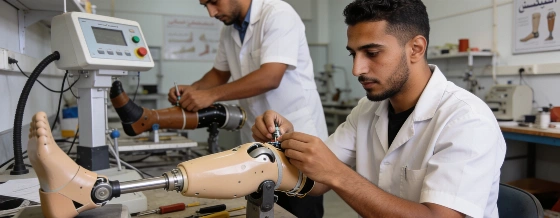
Libya is advancing plans to localise its prosthetics industry by attracting international companies, aiming to transfer expertise, develop local skills, and reduce reliance on treatment abroad. The initiative could strengthen national healthcare capacity.
Libya is moving to localise its prosthetics industry by encouraging international companies to establish branches and centres within the country. The initiative is designed to facilitate the transfer of advanced expertise and technology, develop the national workforce, and reduce the need for Libyans to seek prosthetic treatment and rehabilitation services abroad.
The strategy was discussed at a meeting held at the National Centre for Prosthetics, chaired by Mohamed Ben Ghalbon, Minister of State for Prime Ministerial and Cabinet Affairs. The session included Al-Sadiq Al-Haddad, Director General of the National Centre for Prosthetics, and Abdulrahman Al-Zawawi, Head of the Libyan Amputees Association. Participants reviewed the Centre's operational needs and explored solutions to existing obstacles, with the goal of improving therapeutic and rehabilitative services for amputees and ensuring care meets international standards.
Focus on Workforce Development and Technology Transfer
Central to the localisation effort is the transfer of modern prosthetics technologies and the upskilling of Libyan professionals. By attracting specialised international companies, Libya aims to build a sustainable domestic industry capable of delivering high-quality care and reducing dependence on foreign medical services.
Implementation Steps and Service Enhancement
Attendees at the meeting stressed the importance of establishing practical steps to implement the localisation initiative. The focus is on enhancing the quality and sustainability of services for amputees, ensuring that improvements are maintained over time and that the sector continues to develop in line with global standards.