

Morocco's electronic scene has won international festival attention, yet organisers still face late permits and limited year-round venues, alongside touring visa barriers. Artists and collectives say durable local spaces and inclusive bookings are essential to its next phase.
Organisers in Morocco can book artists and sell tickets while municipal authorisation remains uncertain until days before an event. That instability sits alongside a shortage of permanent club spaces, leaving a growing electronic scene reliant on seasonal festivals and temporary builds. Independent scenes across MENA have built their own infrastructure amid venue shortages and currency crises, with border restrictions and political instability also shaping their work. Promoters often rely on self-financed parties and independent labels, staging events in temporary venues.
The challenge now is physical infrastructure. Marjana Jaidi, founder of Oasis Festival, says elaborate installations have become difficult to justify in a three-day format, given the budget and single-use materials involved. A permanent venue, she argues, would give organisers room to take creative risks.
Festival reach meets a year-round infrastructure gap
Morocco's boutique festivals helped change international perceptions of North Africa. Oasis Festival launched in Marrakech in 2015, followed by MOGA Festival in Essaouira in 2016. MOGA's format combines electronic music with regional heritage, wellness and artistic exchange; after editions in Morocco and Portugal's Costa da Caparica, organisers announced a Dakar edition for November 20, 2026, at Maison CSS. The planned programme brings international electronic acts together with regional artists from Africa and MENA. Jaidi recalls that some local audiences doubted the artists would actually arrive for the first Oasis edition. It took three to four years of delivering a high-quality event to convince artists who were hesitant to travel to Morocco.
The festivals also made room for contemporary Moroccan culture. Oasis brought local gastronomy and visual arts into its programme, while domestic selectors gradually moved into more prominent booking slots. In 2023, the festival introduced its first dedicated all-Moroccan stage.
Growth has not removed operational uncertainty. Jaidi says municipal permissions may arrive only days before an event, even when applications were submitted early. Organisers must book artists and pay vendors without knowing whether authorisation will come through. Separate from municipal permissions, Morocco's Bureau of Authors' Rights and Neighbouring Rights (BMDAV) requires prior written authorisation for musical events under Law No. 2-00. Its event declaration covers details such as the date, venue capacity and ticket prices, as well as performers, fees and works to be performed, as described in BMDAV's event guidance. The Fragments crew, made up of Yassir, Rikku, and Ocean, describes a future cultural complex with workshops and record shops, alongside space for music and art.
Local scenes shape their own sound
Morocco's electronic music draws on a deep musical inheritance. The qraqeb's polyrhythmic snap and Amazigh percussion sit within a broader tradition of Sufi chanting and Gnawa lilas, long associated with trance and communal experience. Industry coverage has also highlighted Gnawa's influence on electronic music in Morocco. Paris-based DJ and producer Glitter55 says her childhood home held Arab music alongside her father's collection of Gnawa and Jil Jilala records.
That history does not dictate a single sound. Casablanca-based producer Kosh, founder of Convergence, describes a city whose noise and energy inform his work. He rejects the expectation that North African electronic music must use obvious traditional samples: "My music doesn't need to sound 'Moroccan' to be Moroccan music." When incorporating North African percussion, Glitter55 says she builds club tracks around the original syncopation rather than fitting it to a rigid European grid.
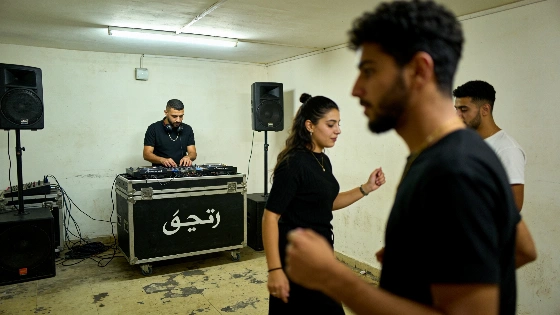
In Casablanca and Rabat, Fragments set out to create places where people could gather and hear unfamiliar music. Its members describe a crowd invested in the sound, contrasting it with Marrakech's high-end nightlife, while pointing to L'envers as a welcoming exception. Small electronic events also continue beyond the festival circuit: the Glitched collective, which has staged events in Casablanca and Agadir, announced a limited-capacity night at Croon Lounge in Rabat as the launch of its season. In the earlier commercial club era, Pacha in Marrakech helped promote electronic music, as did Platinum and Choc'late. Amine K says the wider culture around it was missing.
Morocco's broader public agenda has also faced scrutiny over inequality and confidence, as discussed in a cabinet delivery assessment. For nightlife, the immediate questions are more practical: whether independent organisers can secure stable spaces and whether lineups make room for women and non-binary artists. Glitter55 argues that mentorship and inclusive curation need to be built into how the scene develops. A regional industry discussion at Amsterdam Dance Event has described independent scenes in cities including Casablanca as building their own infrastructure against venue shortages and other barriers.
Touring barriers and the next phase
International mobility remains another constraint for Moroccan artists. Amine K says obtaining a French passport in 2016 changed his career by removing the months of paperwork and uncertainty that had accompanied each international booking. Kosh has also described tour dates lost to administrative delays.
Moroccan electronic music has established its artistic standing through festivals and independent collectives, with artists working across borders. Its next stage depends on whether organisers can build lasting local infrastructure and keep space open to a wider range of artists. Amine K describes the exchange with audiences at home this way: "When you play in Morocco, and the crowd connects with you, the energy they give back is unreal. It's a pure exchange of emotion, passion, and love that you rarely find anywhere else in the world."







