Morocco's agri-food exports to the EU reached €2.66 billion in the first seven months of 2026, up €39 million year on year. Fresh fruit and vegetable shipments fell in the latest marketing year.
In 2025, the EU imported €3.753 billion in agri-food goods from Morocco, up from €3.460 billion in 2024. The latest figures show a different trend for fresh produce: shipments to the bloc fell during the 2025-2026 marketing year.
European Commission data put Moroccan agri-food exports to the EU at €2.66 billion, or US$2.9 billion, in the first seven months of 2026. That was €39 million more than the €2.621 billion recorded in the same period of 2025. Morocco's state news agency, MAP reporting, covers the country's economic and agricultural developments. Trade comparisons still need consistent reporting periods, and export value is not the same as shipment volume.
Value rose. Volumes fell.
For the full year 2025, EU agri-food imports from Morocco were up 8.5% from 2024. The figures show the importance of the European market to Moroccan exporters. They do not mean that every product's shipments will rise in every season.
Morocco exported 2.38 million tonnes of fruit and vegetables in 2025. Around 1.47 million tonnes, or 62%, went to the EU. France, Spain and the Netherlands were the main EU destinations. In the 2025-2026 marketing year, EU imports of fresh fruit and vegetables from Morocco fell to 1.37 million tonnes, about 10% below the previous campaign.
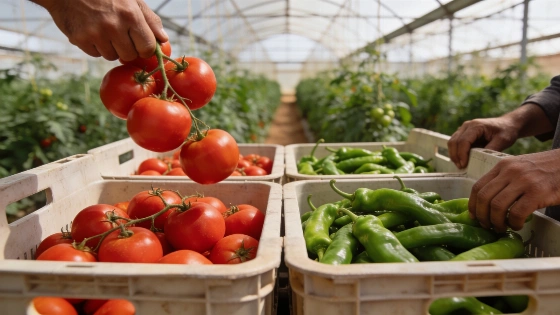
Tomato shipments also fell. Season summaries put the volume at about 503,000 tonnes, down from 563,000 tonnes. A separate Hortoinfo analysis, based on Euroestacom and Eurostat data, counted about 493.3 million kilograms. That was 17.74% of EU tomato imports. The two figures come from separate reported series and should not be treated as identical.
Both accounts put Morocco in second place among EU tomato suppliers, behind the Netherlands and ahead of Spain. In the Hortoinfo analysis, the Netherlands supplied 773.45 million kilograms. Moroccan pepper imports reached 165,000 tonnes.
Morocco kept a substantial share of the market. But the latest campaign brought lower produce volumes. The tomato ranking measures market position, not uninterrupted growth in tonnage.
Greenhouse production, irrigation infrastructure and export logistics have helped Moroccan suppliers. The country's proximity to European markets also helps its tomatoes and peppers compete in winter, when Northern European production is more limited. Eurostat and Euroestacom data cited in the draft show Moroccan tomato exports to the EU rose about 44% between 2013 and 2025, despite the latest seasonal drop.
Logistics also shape Morocco's wider trade position. DHL's market assessment cited the country's role in connecting European and African supply chains.
Regional comparisons need care. Morocco's MAP, Algeria's APS and Tunisia's TAP report national developments. The UN Economic Commission for Africa, or UNECA, offers a wider continental view. Comparing those figures with EU data requires matching product classifications and time periods. UNECA's regional economic resources provide broader context, but they do not replace the specific EU import series used here.
Morocco's agri-food exports to the EU rose from €3.460 billion in 2024 to €3.753 billion in 2025, even as fresh-produce volumes later weakened. The trade balance with the EU remained in Morocco's favour. That supports foreign-exchange earnings and agricultural employment. But market access and infrastructure cannot shield supply from weather, production conditions or shifts in demand.
Morocco remains a major EU supplier, but export-value growth does not prove that shipments keep rising. The next marketing-year data will show whether fresh-produce volumes recover. For now, Morocco's position depends on staying competitive as the flow of goods grows less steady.