
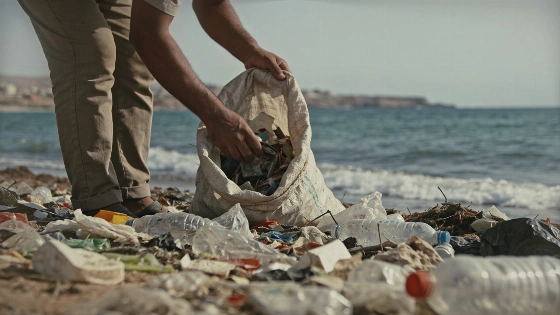
Greenpeace estimates that plastic pollution causes about $1.2 billion in annual damage to Morocco's Mediterranean marine ecosystems. Its wider regional report puts the yearly cost across Morocco, Egypt and Tunisia at $1.7 billion to $5.5 billion, alongside major gaps in waste collection and processing.
The estimate covers Morocco's Mediterranean marine ecosystems. It leaves out the Atlantic coast and direct losses to tourism, fishing and other activities. A Greenpeace MENA report puts the annual damage at $1.2 billion, nearly 12 billion dirhams, or around 0.8% of GDP.
That figure sits within a wider regional estimate. A September 2026 Greenpeace MENA assessment puts annual damage across Morocco, Egypt and Tunisia at $1.7 billion to $5.5 billion. Cumulative damage across the three countries could reach $30 billion to $98 billion by 2040. The regional totals are summarized by CFS Global. They are Greenpeace estimates, not government accounts attributed to Morocco's MAP, Algeria's APS or Tunisia's TAP.
Three countries are included. Morocco's waste collection coverage varied sharply in 2019: about 96% in urban areas, compared with around 10% in rural areas. The gap points to the difficulty of extending collection beyond cities, rather than a uniform nationwide shortfall.
Morocco produces an estimated 422,000 tonnes of plastic waste each year. Around 250,000 tonnes are inadequately managed, and approximately 75,000 tonnes reach the sea, according to figures reported by Moroccan outlet Hespress. The figures point to gaps in collecting and processing waste before it reaches the marine environment.
Capacity on paper is not capacity in operation. Of 26 planned sorting centres, nine have been built and only three are operating, according to the report's figures relayed by Hespress's report. Plans are not enough. The gap helps explain why planned facilities have yet to provide enough sorting capacity.
Morocco has laws that address plastic bags, including Law 22.10 of 2010 and Law 77.15 of 2015. The report's criticism is not that regulation is absent. It says implementation and sorting infrastructure remain insufficient. The reported figures show shortfalls in operations, but do not establish how much of the waste problem stems from enforcement, funding or local service arrangements.
Greenpeace estimates that damage to Mediterranean marine ecosystems in Morocco could reach around $22 billion between 2026 and 2040. That projection excludes Morocco's Atlantic coast and direct economic losses to tourism, fishing and other activities. It is separate from the wider three-country projection, which covers a different area.
Other reporting has examined Morocco's role in trade logistics, including a DHL market assessment. Greenpeace's figures address a different question: whether waste services can keep plastic out of the sea.
Greenpeace recommends expanding rural waste collection and putting existing sorting centres into service. It also calls for producer responsibility to cover all packaging, support for bringing informal waste collectors into the formal system, and a global treaty to reduce plastic production.
Morocco's immediate problem is the gap between planned facilities and working capacity, alongside sharply uneven collection coverage. The annual damage is already estimated at nearly 12 billion dirhams. The test is practical: improve rural collection and put built sorting centres into operation.