

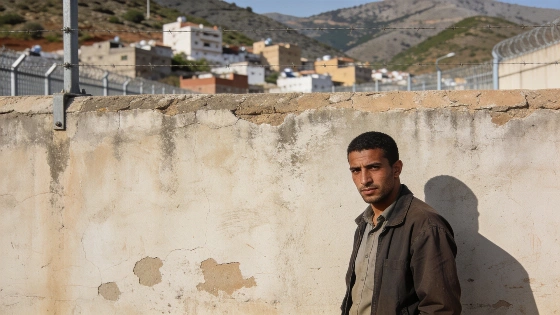
A decade after Mouhcine Fikri's death sparked protests in Al Hoceima, six prominent Hirak figures remain jailed. Unemployment and weak public services, alongside security pressure, continue to fuel demands for dignity across the Rif.
From prison, Nabil Ahamjik completed a master's thesis on the Rif's relationship with the state, earning an 18 out of 20 and a recommendation for publication. He is serving a 20-year sentence. In September 2026, he staged a 10-day hunger strike after authorities denied him a proper space to work on his PhD.
Six prominent Hirak figures remain in prison, including movement leader Nasser Zefzafi, who was also sentenced to 20 years. Nabil Ahamjik is also serving a 20-year term. Between 2018 and 2021, around 280 Hirak detainees were released through royal pardons, but senior figures remained behind bars. The movement's leaders were imprisoned after protests over poverty and marginalisation in Morocco's northern Rif region.
Prison sentences and family costs
Nabil's brother Mohamed has worked to raise awareness about his case since the arrest in 2017. "Our family has been through a lot. My mother's health has deteriorated, but despite everything, she continues to hold on," he told Middle East Eye. He described his advocacy as "a duty towards my mother, my brother Nabil and our family".
The protests began after fishmonger Mouhcine Fikri died inside a rubbish truck in Al Hoceima on 28 October 2016 while trying to retrieve his confiscated catch. Jeune Afrique describes the fish as swordfish, a protected species prohibited from sale, and says Fikri's death "set the Rif ablaze." The tragedy brought longstanding grievances over poverty and poor job prospects, alongside inadequate healthcare and weak infrastructure, into the streets. Protesters called for better hospitals, including oncology services, and improved schools. They also demanded roads and factories to create jobs, along with recognition of the Rif's cultural identity.
Authorities tolerated demonstrations for several months, then intensified a crackdown from late May 2017. Contemporary reporting put arrests at more than 400, while other accounts described roughly 500 people as imprisoned or prosecuted. Authorities branded the movement separatist; historian Maati Monjib called this "false accusations made to discredit their demands" in comments to MEE. Amnesty International has challenged the fairness of the trials, describing the protesters' actions as essentially peaceful and focused on public services.
On 20 July 2017, riot police used tear gas and batons to disperse demonstrators in Al Hoceima. Imad el-Attabi, then 22, was severely injured and died the following month. Solidarity protests spread across Morocco during the summer. In 2024, the UN Working Group on Arbitrary Detention classified Zefzafi's detention as arbitrary and called for his release; the finding did not change his Moroccan sentence.
Repression across the Rif and diaspora
Rights groups have denounced arrests of Rif protesters and reported allegations of torture and ill-treatment in custody, as well as fair-trial violations. Journalists covering the protests and activists abroad were also caught up in the repression. Said El Amrani, a digital creator and human rights activist born in the Rif, moved to Belgium in the 1990s. He said at least 11 activists had been arrested on arrival in Morocco since the movement began; two were sentenced to prison, and one remains jailed.
El Amrani told MEE that he had also been targeted online, including through manipulated images taken from his personal social media account. He said authorities had built at least five new police stations in the region since the protests. His account points to the security presence residents describe alongside continuing economic grievances.
The Rif's history of resistance stretches back beyond the Hirak. The Rif War, fought from 1921 to 1926 against Spanish and later French colonial forces, ended with the defeat of the self-proclaimed republic led by Abdelkrim El Khattabi. After Morocco gained independence in 1956, the army under Crown Prince Hassan suppressed uprisings in the Rif and other regions. Jamal El Khattabi, who was arrested twice under Hassan II, told MEE he was beaten and tortured during detention in 1989.
Unmet demands and departure
The 2011 constitutional changes raised hopes of lasting reform, but repression intensified in the years that followed. During the 2025 Gen Z protests, corruption and unemployment were among the concerns, alongside public services. Information from the account, 6,000 people were arrested. A year later, around 700 remained in jail, including dozens of minors, the Moroccan Association for Human Rights said.
Economic chance remains uneven. Youth unemployment is 37 percent, while residents of the Rif face few job prospects and limited access to specialised healthcare. A faculty affiliated with the University of Tetouan has opened, but El Amrani said a newly built hospital lacked enough medical staff. Many young people have left for Tangier or Tetouan; others have travelled clandestinely to Europe.
As controls tightened on the borders with Ceuta and Melilla, informal trade that had supported borderland families became impossible. In summer 2026, tens of thousands attempted to cross into Ceuta, including many young people from the Rif. El Amrani told MEE: "They feel they have no future. For them, the only solution is to leave." A report on young peripheral candidates likewise placed public services and accountability at the centre of political representation.
Ten years after the protests began, a commemoration in Utrecht marked the anniversary, linking Fikri's death to the movement and its demands. Monjib said repression had largely paralysed the Rif movement and shifted its focus towards the release of political prisoners, while its pursuit of equality endured. "There continues to be a deep desire for dignity and equal recognition, where a Moroccan, in the Rif or elsewhere, should be the equal of every other Moroccan, regardless of status or background," he told MEE.







