
Morocco's plan to end its reliance on Spanish gas infrastructure has hit a wall after the suspension of the Nador West Med terminal project, leaving the country's energy security tethered to Madrid and exposing Rabat to ongoing political and supply risks.
Morocco's effort to reduce its dependence on Spain for gas and electricity has come to a halt. The government's main initiative-a Floating Storage and Regasification Unit (FSRU) at the Nador West Med port-has been suspended, leaving the country's energy strategy uncertain and its reliance on Madrid unchanged. The Moroccan Ministry of Energy Transition had described the Nador FSRU as central to national energy independence, but its status remains unclear in official statements, according to the national news agency MAP and recent industry reports.
The numbers highlight the imbalance. In 2025, Spain sent 3.88 TWh of electricity to Morocco, while Moroccan exports to Spain were just 132 GWh. The gap is even wider in natural gas. Since Algeria stopped sending gas through the Maghreb-Europe (GME) pipeline in 2021, Morocco has had to buy liquefied natural gas (LNG) on the open market, regasify it in Spain, and then send it back through the GME pipeline to power its own plants. The African Union's energy policy division has noted the region's exposure to supply disruptions under this setup.
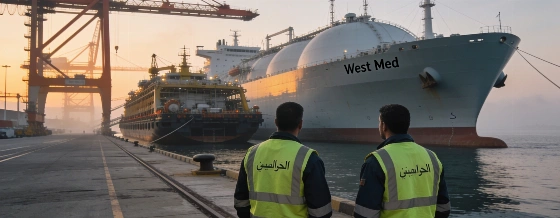
The Nador FSRU was supposed to change this: a terminal with a capacity of 5 billion cubic meters per year, directly linked to the GME and Morocco's main gas users. The plan was to bring LNG ships to Morocco, regasify the fuel locally, and feed it into the national grid-removing Spain from the process and reducing outside leverage. But as of September 2026, only the container terminal at Nador West Med is operational, with the first phase set to handle up to 3.5 million TEU per year. The gas terminal remains on hold (Morocco World News).
Project suspension exposes strategic vulnerability
In early 2026, the government suspended tenders for both the gas terminal and its pipelines, citing unspecified changes in "parameters and hypotheses." No new timeline has been given. Until the FSRU project resumes, Morocco must keep buying LNG, rely on Spanish regasification, and use the GME pipeline in reverse to keep its power plants running. Public investment in the Nador West Med complex has already topped 51 billion dirhams, but progress in 2026 has been limited to container shipping, not energy infrastructure, according to government and industry updates.
This is more than a technical setback. In the Maghreb, energy infrastructure is often used as a political tool, as seen when Algeria closed its pipeline in 2021. The Nador project was meant to give Morocco more control. Its suspension leaves the country exposed to the same risks that have shaped its energy policy for years. The Algerian Press Service (APS) and regional diplomatic sources have repeatedly pointed to the geopolitical importance of energy transit and infrastructure in North Africa.
Rising demand and the limits of renewables
Morocco's own forecasts add to the urgency. The Ministry of Energy Transition expects national gas demand to jump from 1 billion to 8 billion cubic meters by 2027, driven by industry and the need to stabilize the grid as solar and wind power expand. Gas-fired plants are still needed to balance renewables, making a secure and independent supply essential. Meanwhile, trade between Spain and Morocco has reached new highs, with bilateral trade at €22.76 billion in 2025 and Spanish exports-mainly fuels, auto parts, textiles, and chemicals-dominating the flow (El Español Invertia).
With the Nador terminal on hold, Morocco's energy planners have no choice but to keep using Spanish infrastructure for regasification and cross-border flows. The GME pipeline, once a symbol of regional cooperation, now shows how quickly strategic assets can become liabilities when politics shift. According to Le360, in the first half of 2026, Spain exported €6.42 billion in goods to Morocco and imported nearly €5.8 billion, showing how closely the two economies are linked.
Morocco's situation is part of a wider trend in the region, where control over infrastructure and resources is often used as leverage. Reports from the Tunis Afrique Presse (TAP) and the UN Economic Commission for Africa note that such projects can quickly change the balance of power before political solutions are found.
By suspending the Nador West Med terminal, Morocco has lost ground in its push for energy independence. The move leaves Spain-and any other country with influence over cross-border flows-with continued leverage. For a government that has made energy sovereignty a key part of its security policy, this is a significant setback. Unless Morocco restarts the project or finds another way to secure its own supply, its energy future will remain tied to decisions made elsewhere.