
A new report from the Sahrawi Observatory for Natural Resources and Environmental Protection challenges the narrow focus on economic value by mapping the full environmental footprint of resource exploitation in Western Sahara, raising questions about data transparency and long-term ecological risk.
The environmental cost of extracting Western Sahara's natural resources is now at the center of the debate. The Sahrawi Observatory for Natural Resources and Environmental Protection has published a report that shifts the focus from profits and ownership to the broader, often overlooked, ecological consequences of extraction, transport, and export. This comes as regional authorities and international media, including the Moroccan state news agency MAP and the Algerian Press Service (APS), draw attention to growing competition over the region's phosphate, fisheries, and renewable energy resources.
At a conference in Shaheed El Hafed, Observatory President Ms. Yaqouta Al-Mokhtar presented the findings of "Plunder Footprint: The Environmental Cost of Natural Resource Exploitation in Western Sahara" to researchers, international representatives, and civil society groups. The report argues that environmental impact cannot be measured only at the mine, port, or processing plant. Instead, it must be tracked across the entire chain-from extraction to export, including the infrastructure and investments that make these activities possible. In early 2026, Morocco signed agreements for "green" hydrogen projects worth about $35 billion, highlighting the scale of new infrastructure and energy projects now shaping the region regional reporting.
Beyond the mine: cumulative and lasting damage
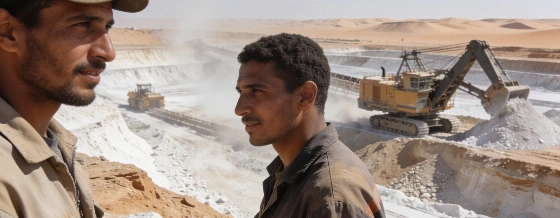
The report uses the idea of an "environmental footprint" to capture the full extent of harm. Phosphate mining, for example, has effects that reach beyond the extraction site-through processing, storage, transport, shipping, and the markets that receive the raw material. The same applies to fisheries, sand extraction, groundwater use, agriculture, industrial projects, renewable energy, and water desalination. Each activity leaves its own mark, and the infrastructure and logistics that support them add to the impact. According to Tunis Afrique Presse (TAP), similar debates about cumulative impacts are happening in neighboring Maghreb countries, where water scarcity and fragile ecosystems make large-scale extraction even riskier.
Ms. Al-Mokhtar noted that Western Sahara's desert, coastal, and marine ecosystems are especially fragile. Water is scarce, and natural renewal is slow, so any damage can be lasting. The report looks not only at where and how environmental impacts occur, but also at how long they last and whether ecosystems can recover-questions that are still unanswered because of a lack of independent data. Recent protests in El-Aaiún against dredging and marine activities, reported by Sahrawi and regional sources, show ongoing local resistance to unchecked resource exploitation.
Data gaps and legal context complicate accountability
The Observatory's analysis connects the ecological crisis to the territory's unresolved legal status. Western Sahara has been on the United Nations list of Non-Self-Governing Territories since 1963. The report argues that any discussion of resource exploitation must also address governance, transparency, and accountability. The United Nations and the African Union have repeatedly called for respect for international legal frameworks, stating that mineral exploration or extraction in Western Sahara without the consent of the Sahrawi people violates international law, as reaffirmed by the 2002 UN legal opinion and recent European Court of Justice rulings.
Ms. Al-Mokhtar pointed out that the lack of reliable environmental data and the barriers to independent monitoring make it difficult to understand the true scale of damage. Without systematic measurement, it is nearly impossible to compare impacts over time or assign responsibility for environmental harm. The report reviews the main economic activities-phosphates, fisheries, sand, water, energy, and infrastructure-then examines the "cumulative impact" of overlapping operations, which often reach far beyond the immediate sites of extraction or production. The international context remains sensitive, with ongoing disputes over trade agreements and export routes, as covered by Politico and regional diplomatic statements.
Baseline for future research and policy
The report concludes that the environmental challenge in Western Sahara is not just a side effect of economic activity. It is made worse by the lack of independent, long-term data needed to measure and manage ecological risk. The Observatory presents its report as a starting point for further research, not a final answer, and calls for more investigation and greater transparency. Regional ministries, such as Morocco's Ministry of Energy Transition and Sustainable Development and Algeria's Ministry of Environment and Renewable Energies, have both acknowledged the need for better cross-border environmental monitoring, though progress has been limited.
For policymakers, investors, and international institutions, the message is clear: without solid data and independent oversight, the environmental costs of resource exploitation in Western Sahara will remain hidden, and the chances for restoration are uncertain. The Observatory's report calls for environmental accountability to be central in any future economic or legal decisions about the territory.