
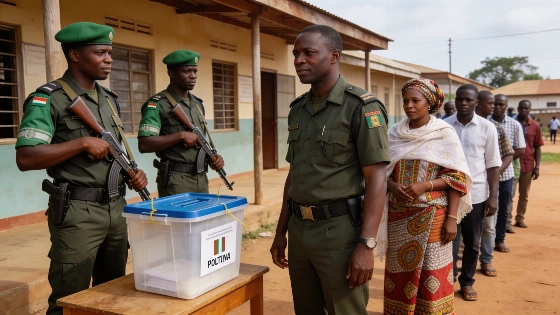
A Nigerian-American security expert warns that Nigeria could face a deeper crisis than Libya if the US and international partners do not ensure credible elections in 2027. Diaspora groups are calling for real oversight as violence and kidnappings increase.
Nigeria's 2027 national elections are approaching under a cloud of rising violence and institutional decline. Diaspora leaders are warning that, without intervention, the country could face a crisis even more severe than Libya's collapse. Dr. Sylvester Okere, a security strategist based in Maryland, puts it plainly: "If America does not pay close attention to Nigeria in this election, what happened in 2023 will happen again, and worse."
Okere argues that Nigeria's security situation has deteriorated to the point where the country risks sliding into a failed state. Mass kidnappings, terrorist attacks, and hunger have become common. Regional agencies, including the Maghreb Arab Press (MAP), have tracked the fallout from Libya's collapse and warn of similar cross-border risks if Nigeria's situation worsens. The violence in Nigeria is severe: churches have been burned, citizens abducted, and rural areas are slipping out of government control. SBM Intelligence reports that between July 2025 and June 2026, 7,825 people were kidnapped, with ransom payments totaling about ₦7.78 billion. In the same period, 895 civilians and 68 security personnel were killed, highlighting the deadly reach of organized kidnapping networks as documented by regional analysts.
Escalating violence and electoral breakdown
Recent intelligence shows that armed groups, including Boko Haram factions, have made kidnapping a major source of income. One group alone is responsible for nearly 90% of ransom collections. Two large abductions in Borno and Niger states accounted for most of the payouts, a pattern that has drawn concern from the African Union's Peace and Security Council. In August 2026, over 500 violent incidents were recorded, and Nigeria Customs seized 603 firearms between January and August, raising fears of armed conflict during the 2027 elections. The 2023 general election saw widespread vote-buying and voter suppression, with turnout dropping to 25.7 percent-the lowest since Nigeria returned to democracy in 1999. International observers from the European Union and United States confirmed irregularities but did not declare the process systematically rigged.
The Independent National Electoral Commission (INEC) has scheduled the 2027 elections in two phases: presidential and National Assembly voting on January 16, followed by governorship and State Houses of Assembly elections on February 6. Security analysts warn that jihadist insurgency and institutional weakness threaten the credibility of the process. INEC has started nationwide readiness checks, including a South-West assessment tour and appeals to traditional rulers to help mobilize voters and reduce tension, as reported by Nigerian and Algerian media. Nigerian commentators are calling for reforms before the vote, such as independent threat assessments in all 774 local government areas, dedicated electoral-security units, and clear rules for postponing elections in high-risk areas.
Diaspora mobilisation and US leverage
Despite sending nearly $23 billion in annual remittances-more than Nigeria's oil revenues-the 850,000-strong Nigerian-American diaspora has mostly stayed quiet as democratic institutions weaken. Okere criticizes this lack of engagement: "Some are passively accepting what is going on, not even being vocal or getting involved to stop the decay." That silence is starting to break. Save Nigeria, a diaspora advocacy group led by Stephen Osemwegie in Minnesota, is expanding its work across North America and Europe to demand peace, justice, and leadership accountability ahead of the 2027 vote.
The United States, which has labeled Nigeria a Country of Particular Concern for religious freedom violations and has conducted joint military operations against Islamic State-linked groups, faces a key decision. Previous US administrations have praised Nigeria's democratic progress while overlooking election flaws. As political coalitions shift, diaspora leaders say Western democracies must treat Nigeria's electoral integrity as a national security issue. The risk of collapse is real-Libya's experience, as reported earlier, shows how fragile elections can trigger wider instability.
Regional stakes and author's analysis
Nigeria's future will affect more than just its own borders. A breakdown in Africa's largest democracy would send shockwaves through West Africa and the Sahel, disrupting regional security and migration management. The Tunis Afrique Presse (TAP) has reported that instability in Nigeria can disrupt trade routes and energy agreements with Maghreb states. The US and its allies cannot afford to treat Nigeria's 2027 elections as a routine diplomatic task. The evidence is clear: rising violence, weakened institutions, and diaspora disengagement are converging into a serious threat. If Washington and international partners do not demand real electoral oversight and accountability, Nigeria could become the next example of state collapse-with consequences that will reach far beyond its borders.