
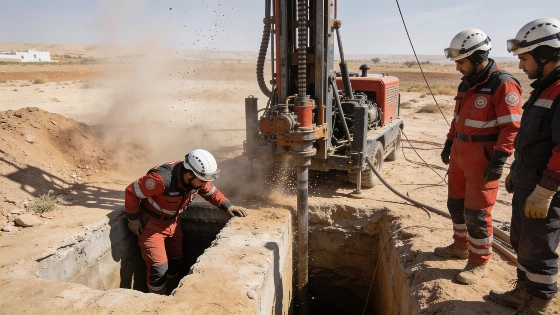
Algerian rescue teams have entered a critical phase as they attempt to reach 10-year-old Ayoub, trapped for four days at the bottom of an 80-metre well in El Bayadh. The operation now hinges on a parallel shaft after direct access proved too dangerous.
Algeria's most urgent rescue operation has reached a pivotal moment. After four days of relentless effort, emergency teams in El Bayadh have abandoned direct extraction attempts and are now drilling a parallel shaft in a last-ditch bid to reach 10-year-old Ayoub, who remains trapped deep underground. The shift in strategy comes as the original well's unstable structure and treacherous geology have repeatedly thwarted conventional rescue methods.
The crisis began when Ayoub, walking through the commune of El Ghassoul, stepped onto a decaying plywood cover and plunged into a narrow, 80-metre-deep artesian well. The shaft, barely 40 centimetres wide and partially filled with earth for the first 30 metres, left rescuers with almost no margin for error. Any miscalculation could trigger a collapse, endangering both the child and the teams below.
Technical Barriers Force Strategic Rethink
Initial rescue attempts quickly ran into insurmountable obstacles. The well lacked any protective metal tubing, and its irregular, winding path made vertical drilling impossible without risking deviation or collapse. Lieutenant-Colonel Nassim Bernaoui of the Protection civile confirmed that Ayoub's position-buried beneath a significant layer of earth-ruled out direct extraction from above. Instead, engineers and civil protection specialists coordinated a complex plan: excavate a new, parallel shaft to the same depth, then tunnel horizontally to reach the boy's location.
Progress has been painfully slow. Heavy machinery has struggled against dense rock and compacted soil, with each metre gained requiring meticulous care to avoid destabilising the fragile environment. The operation is under constant scrutiny from local authorities, with the Director General of the Protection civile personally overseeing the site. High-precision imaging equipment has been deployed to map the underground labyrinth and guide the rescue teams' every move.
National Mobilisation and Operational Risks
The rescue has drawn in a coalition of public and private expertise, including deep-drilling contractors and technical consultants. The entire region is watching, with the operation's risks and stakes echoing recent high-profile emergencies in Algeria. As seen in reported earlier cases, the ability of Algerian authorities to coordinate complex, high-risk interventions is under the spotlight.
For Ayoub's family and the wider Algerian public, the wait is agonising. The rescue's outcome will be measured not only by technical achievement but by the state's capacity to mobilise resources and expertise under extreme pressure. Every hour lost to geological setbacks or equipment delays increases the risk, while the emotional toll on the community intensifies.
Editorial Analysis
This operation exposes the chronic dangers posed by neglected rural infrastructure and the limits of emergency response in Algeria's interior. The absence of basic safety measures-such as reinforced well covers and proper shaft lining-turned a preventable accident into a national ordeal. While the technical skill and determination of the rescue teams are undeniable, the underlying vulnerability remains: without systemic investment in rural safety and rapid-response capacity, similar tragedies will recur. The outcome for Ayoub is still uncertain, but the lesson for Algerian authorities is clear-heroic rescue efforts cannot substitute for prevention and modernisation. The country's ability to protect its most vulnerable citizens will be judged not only by the drama of this rescue, but by the reforms that follow.