
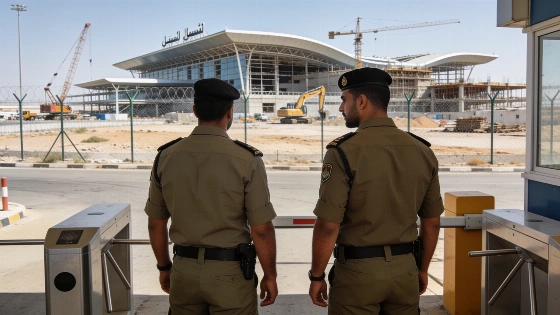
Libya's Ministry of Transport has finally confirmed Tripoli International Airport will not open before Q4 2026, ending months of official silence and raising questions about the project's transparency and operational readiness after years of delays and restricted access.
The long-shrouded fate of Tripoli International Airport is no longer a matter of speculation: Libya's Ministry of Transport has quietly admitted the new facility will not open before the fourth quarter of 2026, two years behind the previously promised schedule. The confirmation, buried in the final line of an official report, ends months of stonewalling by authorities who had refused to provide either a timeline or even updated images of the construction site.
For nearly a decade, the ruins of the old Tripoli International Airport have stood as a symbol of Libya's institutional paralysis. Destroyed in the militia battles of summer 2014, the airport's reconstruction was initially entrusted to a consortium of Italian firms, with a 2024 opening date that has now slipped into the distance. The project's opacity has only deepened public frustration: media and unauthorized personnel have been kept behind a strict security cordon, and repeated requests for progress updates have been met with silence.
Delayed Timeline and Official Evasion
The Ministry's admission came not in a press conference, but as a footnote to a meeting summary chaired by Khaled Swesi, Undersecretary for Air Transport Affairs. The session, held at the Ministry's Tripoli headquarters, brought together representatives from the Libyan Internal Investment and Development Fund (LIIDF) and domestic airlines to review operational requirements and coordinate readiness activities. Only in the closing sentence did the Ministry acknowledge the new opening target: "the fourth quarter of 2026."
Until now, authorities had consistently refused to confirm any date, let alone provide visual evidence of progress. The security perimeter around the site has been enforced with unusual rigor, effectively shutting out independent scrutiny. This approach has done little to inspire confidence among stakeholders or the public, especially given Libya's track record of stalled infrastructure projects.
Operational Readiness and Stakeholder Involvement
The recent meeting focused on technical and operational requirements for the airport's eventual launch. Representatives from airlines and the LIIDF discussed their roles in preparing for the facility's operational readiness, but the lack of transparency over construction progress remains a glaring issue. The Ministry's decision to reveal the opening date only in passing, rather than as a headline announcement, suggests a reluctance to confront the project's delays head-on.
For airlines and investors, the shifting timeline complicates planning and resource allocation. The airport's delayed return also prolongs Libya's reliance on alternative, less capable facilities, with direct consequences for connectivity, trade, and the broader economy.
After years of obfuscation, the Ministry's belated confirmation of a 2026 opening is less a sign of progress than an admission of persistent dysfunction. The refusal to allow independent oversight or even basic transparency signals a government more concerned with controlling the narrative than delivering results. Until authorities open the books-and the gates-on Tripoli International Airport, confidence in Libya's ability to execute strategic infrastructure will remain as grounded as the airport itself.