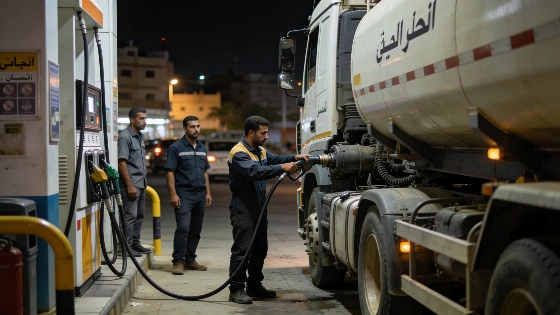
Brega Petroleum Marketing Company has opened three dedicated 24-hour diesel stations in Tripoli to tackle severe shortages and keep truck operators supplied, stabilising distribution amid ongoing power cuts and black-market price surges.
Brega Petroleum Marketing Company has opened three fuel stations in Tripoli that operate around the clock and supply diesel specifically to trucks. The move comes as the city faces persistent diesel shortages, worsened by widespread power cuts and surging black-market prices. Truck operators have struggled to access fuel during these disruptions and stand to benefit directly from the new stations.
The initiative follows instructions from the Tripoli government to prioritise support for truck operators during the summer, when power outages disrupted normal petrol station operations. The resulting scarcity pushed black-market diesel prices as high as LD 8 per litre, compared with the official rate of LD 0.15 per litre. Many residents and businesses have had to pay inflated prices to keep generators running. That has pushed truck drivers further down the priority list, affecting trade and industry.
These supply pressures are part of a wider national fuel-distribution problem. UN Special Representative for Libya Hanna Tetteh told the Security Council in October 2026 that Libya imported about 8.15 million tonnes of fuel in the first nine months of the year, at a cost of approximately $8.9 billion. She said an estimated 30% to 50% was diverted through smuggling networks, with potential losses of up to $4.4 billion. Tetteh said the state faced “an increasing budgetary burden for subsidized fuels from which the population does not benefit once they are diverted”, information from reporting on her UN briefing. The official pump price, around LD 0.150 per litre, leaves a large gap with prices across borders and on the black market.
Government Response and Security Measures
Brega said the stations' opening is part of the Committee for Improving Basic Services for Citizens, which operates under the Prime Minister's mandate. The company is coordinating with the Regional Security Directorates Support Agency to keep fuel distribution orderly and secure. The agency manages and safeguards supply operations at the newly opened stations: Station 406 (Al-Ahya Al-Barriya), Station 396 (Al-Hadba Project) and Station 062 (Al-Hadba Project).
Electricity shortages are adding to diesel demand: gas supplies roughly 70% of Libya’s electricity generation, while outages in some areas have lasted six to ten hours. Households and businesses increasingly rely on private generators, putting them in competition with transport operators for fuel. Problems across power generation, transmission and distribution are compounding the fuel shortages.
Additional Capacity and Next Steps
To ease supply bottlenecks further, the agency is preparing two mobile stations on Airport Road, near the former traffic-light location. They will enter service once equipment installation is complete. The measures are intended to regulate truck traffic, maintain diesel supplies to the transport sector and limit the economic impact of fuel shortages on Tripoli's logistics and trade.
Infrastructure upgrades are also on the national agenda. At its annual technical meeting on 19 October 2026, the National Oil Corporation’s Oil Industries Department and Brega reviewed fuel-supply operations, including depot readiness, storage capacity, loading facilities, transport and pipeline-pumping constraints. The department director highlighted the need “to improve infrastructure efficiency, increase storage capacity, and improve the readiness of depots and loading and unloading facilities”, according to the Libyan News Agency’s account of the meeting.
Brega’s wider plans include a depot project in Tajoura designed to store 226,300 cubic metres of petrol, diesel, kerosene, jet fuel and liquefied petroleum gas, alongside a cylinder-filling unit rated at 1,200 cylinders per hour. Brega and OLA Energy are developing the project to strengthen regional storage and distribution capacity. It is a longer-term infrastructure measure, separate from the stations opened for truck operators.