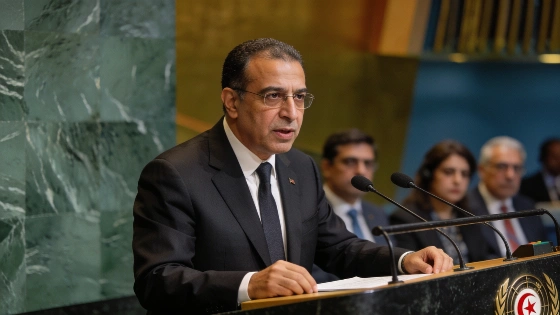
At the 81st UN General Assembly, Tunisia's foreign minister condemned Israeli measures in Jerusalem and warned that dismantling UNRWA would threaten Palestinians' right of return. He also restated Tunisia's rejection of a transit role for irregular migrants.
In New York, Foreign Minister Mohamed Ali Nafti condemned forced displacement and home demolitions in Jerusalem, along with attacks on Muslim and Christian holy sites.
At the 81st UN General Assembly, he also warned that attempts to dismantle UNRWA would threaten Palestinians' right of return. Tunisia's state news agency TAP has reported on the government's positions on Palestinian rights and migration management.
Nafti condemned settlement expansion in the occupied West Bank and what he called "acts of genocide in Gaza." He urged the international community to address what he described as the "historic injustice" suffered by Palestinians. That was his warning.
He said any attempt to dismantle UNRWA or undermine its mandate would threaten both the right of return and the Palestinian cause. In September 2026, UN Secretary-General António Guterres said the agency's mandate was under threat. The General Assembly had extended it for three years in December. UNRWA continues to operate in Gaza, the West Bank, including East Jerusalem, as well as Jordan, Syria and Lebanon, according to the UN briefing.
Restrictions on the agency have escalated. Israeli authorities began demolishing UNRWA's main Sheikh Jarrah compound in East Jerusalem in January 2026, after Israel's parliament passed legislation restricting the agency's operations in late 2024. UN reporting has also described the closure of schools and medical centres in East Jerusalem, the takeover of the Qalandia training centre, and limits on access to water and electricity.
UN materials report that about 400 UNRWA staff members were killed in Gaza. Hundreds of facilities in the occupied Palestinian territory are inaccessible, severely damaged or destroyed. The agency remains on the ground.
Interim Commissioner-General Christian Sanders said UNRWA was going through a very difficult period but would keep supporting Palestinian refugees for as long as the General Assembly required. Jordan, Brazil, Türkiye and Palestinian representatives have also condemned the closure, occupation and demolition of UNRWA facilities in East Jerusalem. Jordan and friendly states have called the agency a lifeline for refugees and urged continued support, according to Jordan's Petra news agency.
Tunisia's public position also connects with domestic pro-Palestinian activism. A related report discusses the detention case involving flotilla organisers: a report on the case.
Nafti also condemned Israeli attacks on Syrian territory. He voiced hope that Syrians would preserve their country's unity and sovereignty across all its territory. That call was clear.
On irregular migration, Nafti called for a "comprehensive and balanced" approach. He said it should look beyond security and address conflict, poverty, inequality, joblessness, weak development and human trafficking. Tunisia, he said, continues to rescue migrants on land and at sea and provide them with care. It also coordinates voluntary returns with the International Organization for Migration and protects migrants' dignity and rights.
Nafti drew a firm line: Tunisia says it will assist migrants but will not become a transit country or a place of residence for them. For Tunisia and its Maghreb neighbours, the debate raises questions about regional cooperation. It also puts the focus on meeting humanitarian needs and responding to economic pressures and irregular migration without shifting responsibility to a single country.
Tunisia rejects measures it says threaten Palestinian rights. It also opposes being assigned a permanent role in irregular migration routes. Nafti put both positions before international institutions. The test is whether those institutions act on the issues he raised.