
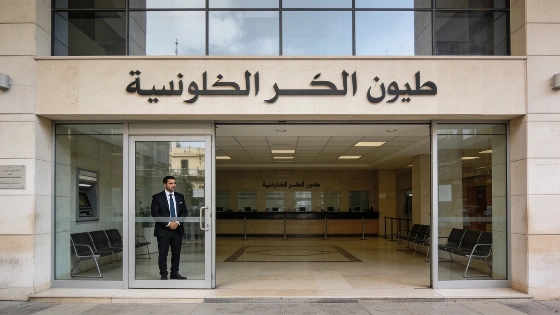
Tunisia's non-resident banks, once intended to channel foreign capital into the domestic economy, now account for just 3.5% of sector assets and are shifting their focus abroad, with declining profits and minimal impact on local financing.
The numbers are stark: Tunisia's non-resident banks, originally designed to funnel foreign capital into the country's economy, have shrunk to a mere 3.5% of the banking sector's assets. Instead of powering local growth, these offshore institutions are now more engaged in overseas operations, leaving Tunisia's domestic economy on the sidelines.
What was once a flagship policy to position Tunisia as a regional financial hub has become a footnote. The Central Bank of Tunisia's 2024 supervision report lays bare the reality-these banks are not only losing ground, but their profits are also sliding. Net banking income dropped 3.5% to $103.9 million in 2024, while net profit fell by 15.2% to $32 million. The sharpest blow came from investment portfolio income, which collapsed by 58.3% to just $3.1 million. The only area holding steady is net interest income, up 4.4% to $66.8 million, now making up 65% of total net banking income. This is less a sign of strategic adaptation than a symptom of a narrowing business model.
Foreign currency flows bypass Tunisia
The original mission for these seven non-resident banks-attracting foreign savings and financing international trade from Tunisian soil-has all but evaporated. Lending to Tunisian residents plunged by more than 15% in 2024, down to $64 million. Meanwhile, loans to non-residents jumped nearly 19% to $304 million. The pattern is clear: these banks are increasingly circulating capital outside Tunisia, not within it.
Deposits with the Central Bank of Tunisia have also dropped sharply, falling 26% to $301 million. Most liquidity is now parked with foreign banks, further disconnecting the offshore segment from the domestic financial system. The sector's operating uses of funds-loans, investments, securities-barely grew by 1% in 2024 after a 7.2% contraction the previous year. Over two years, activity has stagnated or declined, a far cry from the ambitions set out in the 1970s and 1980s when these banks were established.
Profitability correction or structural decline?
While the drop in net profit from $37.7 million in 2023 to $32 million in 2024 might look dramatic, it follows an exceptional one-year surge from $14.8 million in 2022. The correction is real, but the underlying trend is unmistakable: profitability is weak, and the revenue base is shrinking. Market income, once a distinguishing feature of these institutions, has dried up, leaving traditional lending as the last pillar of earnings. The cost-to-income ratio, at 33.4%, remains manageable but is inching upward as revenues fall.
These developments are not isolated. Tunisia's broader economic environment is inhospitable to foreign direct investment, with deteriorating sovereign credit and persistent uncertainty. Non-resident banks, positioned at the interface between Tunisia and international capital, are inevitably exposed to these headwinds. The Central Bank's report records the symptoms but does not diagnose the disease. For a parallel, Algeria's banking sector has also faced turbulence, as reported earlier, highlighting a regional pattern of financial sector strain.
From showcase to warning sign
Half a century after their creation, Tunisia's non-resident banks have become a mirror of the country's economic vulnerabilities rather than a showcase for its financial appeal. Their marginal role, declining profits, and growing detachment from the domestic economy signal a model running out of steam. The offshore tool that was supposed to attract and deploy foreign currency for Tunisia's benefit now facilitates its circulation elsewhere, offering little to the host economy. The evidence is unambiguous: unless Tunisia's broader investment climate improves, these banks will remain a peripheral, increasingly irrelevant segment-more a warning sign than a solution for the country's financial ambitions.