
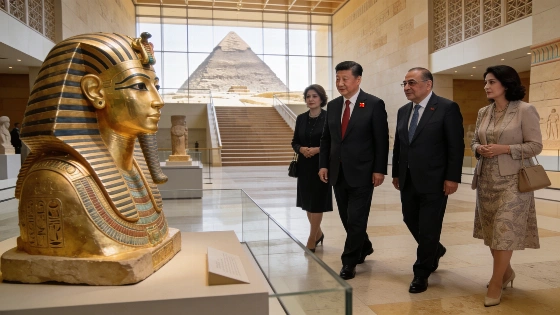
Chinese President Xi Jinping and Egyptian President Abdel Fattah Al-Sisi used a high-profile tour of the Grand Egyptian Museum to push for deeper cultural ties and promote the Global Civilization Initiative, signaling a strategic alignment between Cairo and Beijing.
Standing before the golden mask of King Tutankhamun, Chinese President Xi Jinping and Egyptian President Abdel Fattah Al-Sisi did more than admire ancient treasures-they staged a calculated display of civilizational diplomacy, leveraging Egypt's newest cultural landmark to advance a shared vision of global engagement.
The joint tour, attended by their spouses Peng Liyuan and Entissar Al-Sisi, was not a routine photo opportunity. Instead, it became a platform for both leaders to publicly endorse the Global Civilization Initiative, a Chinese-led framework that calls for "inclusive coexistence" and mutual learning among nations. The symbolism was unmistakable: two of the world's oldest civilizations, each with a vast heritage, aligning their narratives in the shadow of the pyramids.
Strategic Messaging Through Cultural Heritage
Xi Jinping's remarks at the museum were pointed. He invoked the "everlasting friendship" between China and Egypt, emphasizing that both countries are not only ancient but also repositories of World Heritage. Xi called for a model of civilization based on "equality, mutual learning, dialogue and inclusiveness," positioning the partnership as a counterweight to global polarization. Al-Sisi, for his part, echoed these themes, highlighting the openness and harmony of both civilizations and explicitly tying Egypt's approach to the Global Civilization Initiative.
The Egyptian president's gratitude for Xi's support during the museum's opening was more than diplomatic courtesy. It signaled Egypt's readiness to deepen people-to-people and cultural exchanges with China, a move that dovetails with Beijing's broader Belt and Road ambitions in the region. The tour, according to Egyptian presidential spokesman Mohamed El-Shenawy, included detailed presentations in both Arabic and Chinese, underscoring the intent to bridge not just governments but societies.
Regional Stakes and Diplomatic Calculations
For Egypt, the Grand Egyptian Museum is more than a showcase of antiquities-it is a statement of national ambition and a tool for international positioning. By hosting Xi Jinping at this venue, Cairo is signaling its willingness to serve as a cultural and diplomatic bridge between Africa, the Arab world, and Asia. For China, the event reinforces its narrative of respectful engagement with non-Western civilizations, a message aimed as much at global audiences as at domestic ones.
The leaders' tour included a close look at the museum's most prized artifacts, from Tutankhamun's throne to royal chariots, with explanations provided along the Grand Staircase and at the observation deck overlooking the pyramids. The visit concluded with Xi praising Egyptian civilization's contribution to humanity and describing the museum as a "global cultural edifice."
What emerges is a clear pattern: both governments are using cultural heritage as a lever for strategic influence. The rhetoric of inclusiveness and mutual respect is not merely aspirational-it is a calculated response to shifting global alignments, with Egypt and China seeking to position themselves as standard-bearers for a multipolar order. The real test will be whether these symbolic gestures translate into sustained cooperation beyond the museum walls. For now, the message from Cairo is unambiguous: Egypt is open to deeper engagement with China, and both are prepared to use their civilizational weight to shape the international agenda on their own terms.