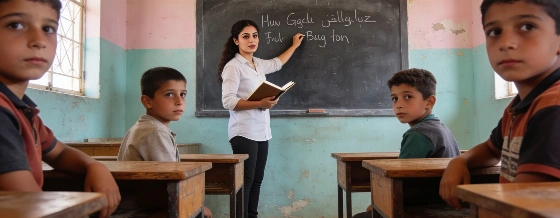
Algeria is fast-tracking English as the primary foreign language in its schools, sidelining French and igniting fierce debate over national identity, teacher readiness, and the country's unresolved colonial legacy. The move signals a calculated break from France amid ongoing diplomatic friction.
Algeria's government has launched its most forceful effort yet to push French out of its education system, making English the first foreign language taught in primary schools. The July 2026 announcement from the Ministry of National Education, reported by La Voie d'Algérie, set English for third-year primary students, with French delayed until the fourth year. This broke with decades of French dominance in Algerian schools since independence in 1962, a point often noted by the Algerian Press Service (APS).
For the first time since independence, Algerian third graders were set to learn English before French. The education minister's July statement was clear: English comes first, French follows a year later. President Abdelmadjid Tebboune ordered the change, framing it as more than a curriculum update-it was a direct challenge to the legacy of French colonialism and a statement of national sovereignty, especially as relations with Paris remained tense. But on 10 September 2026, Algerian media including TSA Algérie reported that the Ministry of National Education had cancelled the July decree, restoring the old order of language instruction. This reversal was formalized by ministerial order No. 36 of 9 September 2026, which cancelled the earlier order No. 20 of 28 July 2026, as covered by Algerie360 and Algeria Patriotique.
Political motives and classroom confusion
President Tebboune described the shift as a practical move, arguing that English is the language of science and international research-a view echoed by the Ministry of National Education and cited by outlets like Algeria Patriotique and Al Quds. The government planned to increase English teaching hours and give it more weight in national exams at the secondary level. But the rollout was chaotic. The main teachers' union, Cnapeste, had warned that the plan was rushed and that teachers were not ready. In July 2026, authorities dissolved the union, officially for violating strike rules, though critics saw it as an attempt to silence opposition.
Parents and teachers were left scrambling. Many worried about the shortage of qualified English teachers, especially after the government's 2022 recruitment drive for 60,000 English teachers-many of them recent graduates with little classroom experience. While this number was widely discussed, it has not been confirmed by official APS bulletins. The gap between policy and reality was clear, a point raised by education specialists and echoed in Tunis Afrique Presse (TAP) coverage of similar reforms in the region.
Colonial legacy and cultural tensions
The language reform was about more than teaching methods. For some, delaying French was an act of national sovereignty. Others saw it as an ideological move rather than a real improvement to education. Critics warned that sending undertrained graduates into classrooms risked lowering educational standards and erasing a cultural and literary tradition rooted in French. French remains the main language in higher education, especially in science and technical fields, as documented by the United Nations Economic Commission for Africa (UNECA).
Medicine and engineering are still taught in French, and most leading academic journals are not available in Arabic. President Tebboune's plan to introduce English for medical studies by 2025 was presented as a step toward international standards, but experts argued the transition was rushed and lacked input from specialists. The debate spilled into public life and social media, where calls to eliminate French entirely gained support. Some political parties, including the Rally for Culture and Democracy and the Workers' Party, pushed back, arguing that language education should be balanced and not driven by ideology.
Diplomatic fallout and regional impact
The timing of Algeria's language shift was not accidental. Relations with France worsened in 2024, after President Emmanuel Macron supported Morocco's claim to Western Sahara, angering Algiers. In France, right-wing media called Algeria's move toward English a deliberate snub. At home, some saw it as a long-overdue break from colonial influence, while others warned it could lead to cultural amnesia and distance Algeria from its large diaspora in France and Quebec. Algeria is still the world's third-largest francophone country, with 15.6 million French speakers-about a third of the population, according to the International Organisation of La Francophonie and APS statistics.
Education experts warned that downgrading French could weaken cultural production and cut ties with the francophone world, even as Algeria struggled to build up English teaching capacity. The government's language policy came as the country faced other challenges, including fiscal pressures and the need to diversify beyond oil and gas, as reported earlier. The September 2026 reversal of the English-first policy, confirmed by several national outlets, highlights the instability and complexity of language reform in Algeria.
Algeria's attempt to overhaul its language policy has exposed deep divisions over national identity, readiness in schools, and the legacy of colonialism. The rapid policy changes and shortage of qualified teachers risk undermining education for a generation. The country's struggle to balance sovereignty, global integration, and cultural heritage remains unresolved, with language policy at the center of the debate.