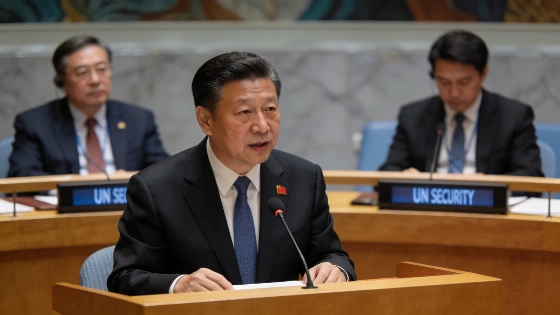
At a UN Security Council briefing, Beijing urged Libya's rival political forces to reach consensus, warning that renewed fighting could erode mutual trust and derail the transition.
Libya's national elections, scheduled for December 2021, were postponed indefinitely. Disputes over electoral rules and who could stand blocked the process, amid questions over the legitimacy of state institutions. The country has held no nationwide elections since Muammar Gaddafi fell in 2011.
The vote remains stalled.
At a UN Security Council briefing on 14 October 2026, Sun Lei, China's deputy permanent representative to the UN, said political dialogue backed by the UN and international partners had made progress. Libya still faced major challenges in completing its transition, he said. Sun called for coordinated international support and urged the country to overcome divisions and achieve lasting peace and stability.
Political division keeps the transition unresolved
Libya's institutional split has persisted since state institutions collapsed following the 2011 overthrow of Gaddafi. Rival political authorities and armed groups have competed for power. Eastern and western structures remain divided over governance, while the UN has linked preparations for national elections to the task of unifying state institutions.
The UN-recognised Government of National Unity is based in Tripoli. An eastern-based administration is backed by military commander Khalifa Haftar. The postponed vote remains a central obstacle, alongside disputes over institutions and executive authority.
Beijing calls for Libyan-led diplomacy
Sun urged international actors to respect Libyan ownership of the political process and press rival forces toward agreement. He called on political leaders to put the country's broader interests first and deepen consensus, while warning against imposed solutions. China said the deadlock and the division of state institutions needed to be addressed as Libya prepares for elections.
Renewed armed conflict, Sun warned, could undermine mutual trust and derail political efforts. He called on the parties concerned to stop attacks and avoid actions that could worsen the situation. Competition among armed groups threatens civilians and Libya's stability.
A key step in the UN-facilitated process came with the Smaller Convening Agreement, also known as the 4+4 committee agreement. Signed in Tripoli on 30 August 2026 after four months of consultations, it sets out a path to parliamentary and presidential elections within 24 months. That timetable depends on forming a unified executive authority and agreeing on institutional procedures. The UN called the deal a political breakthrough but stressed the need for broad Libyan support. Libya's High State Council rejected it on 5 October, leaving the process contested. The development followed the earlier Libya report.
UNSMIL chief Hanna Serwaa Tetteh told the Security Council on 14 October that the process had made encouraging progress. She urged Libyan leaders to prevent obstruction of the agreement.
The mission said it would keep working with a broad range of Libyan participants, drawing on recommendations from its advisory committee and structured dialogue. It is also consulting political and social groups. Tetteh said international and regional support remained essential to progress.
Contacts between eastern and western military structures have continued. Their chiefs of staff met in July. September talks involved naval and air-force representatives, with air-defence representatives also taking part. The sides advanced plans for a joint information-sharing and coordination centre focused on border security. Separately, 14,066 explosive items were cleared between January and September 2026 in the area of Al-Sweihli farm in Misrata.
Sun said China hoped the agreement would help unify Libya's state institutions and lay the groundwork for national elections and a complete political transition. China was ready to keep working with all parties to support peace and stability, he said. The UN's 14 October assessment reported political progress but said the situation remained fragile in economic and security terms. The UNSMIL briefing and Security Council transcript set out the latest diplomatic developments and calls to sustain the process.