
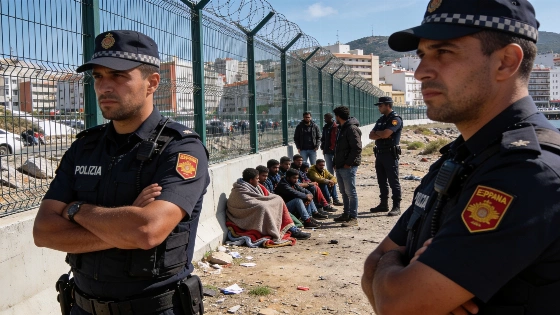
Ceuta's president Juan Jesús Vivas has broken with Madrid and urged the EU to confront Morocco and fund urgent border security, warning that the Spanish exclave faces collapse after 80,000 migrants entered in a single day and over 150 died at sea.
"If Ceuta falls, Europe falls." With those words, Juan Jesús Vivas, president of the Spanish exclave on Africa's northern tip, delivered a blunt ultimatum to EU officials in Brussels. The city, he warned, is buckling under the weight of a mass migrant influx that left more than 150 dead and has exposed the limits of Spain's and Europe's migration strategy.
Vivas did not mince words about the source of the crisis. He accused Morocco of pursuing a "policy of harassment" against Ceuta, directly challenging the Spanish government's softer line and its insistence on treating Rabat as a "trusted partner." The Ceuta leader's public break with Madrid's approach has forced the migration issue-and Spain's relationship with Morocco-back onto the EU's agenda.
Ceuta's breaking point and the EU's muted response
On 30 July, some 80,000 migrants surged across the border into Ceuta, overwhelming local authorities and leaving thousands of third-country nationals, including unaccompanied minors, stranded in the city. The humanitarian fallout was immediate and severe: over 150 people drowned at sea, and the city's infrastructure teetered on the edge of collapse. Vivas, meeting with three EU commissioners and lawmakers in Brussels, demanded urgent financial support for border infrastructure and humanitarian management, as well as concrete EU pressure on Morocco to respect Spanish territorial integrity.
Despite the scale of the crisis, the European Commission offered only vague assurances, dispatching a technical mission to "assess the situation" but making no binding commitments. The EU continues to finance Morocco's migration management with €160 million through 2027, a policy Vivas stopped short of demanding be suspended-unlike Spain's far-right Vox party, which has called for a funding freeze.
Madrid's stance and the regional stakes
Spain's national government, led by Pedro Sánchez, has refused to directly blame Morocco for the border breach, instead pointing to social media misinformation and human traffickers as the main culprits. This position, echoed by the European Commission, has left Ceuta's leadership isolated and its residents fearful of another sudden influx. Vivas openly questioned Madrid's reluctance to hold Rabat accountable, referencing a leaked police report that suggested Moroccan forces played a role in the July crisis.
As Europe's only land border with Africa, Ceuta and Melilla occupy a unique-and vulnerable-position in the EU's migration architecture. Vivas is now pushing for a "special status" for both cities, with migration rules tailored to their circumstances and a permanent presence of the EU asylum agency (EUAA) and Frontex on the ground. The stakes are not limited to Spain: the city's collapse would send shockwaves through the EU's external border system and embolden actors willing to use migration as leverage.
Regional context and what to watch next
The Ceuta crisis is not an isolated event. Across North Africa, migration flows and border politics are reshaping relationships between states and the EU. As seen in Libya's efforts to attract foreign investment for reconstruction, detailed in our previous investigation, the region's stability is increasingly tied to how governments manage cross-border pressures and external partnerships.
For now, Brussels has promised only to send a technical team to Ceuta. Whether this leads to real policy change or simply more bureaucratic delay will reveal how seriously the EU takes the threat to its southern frontier. Vivas's warning is clear: the current approach-outsourcing border control to partners who may weaponise migration-has reached its breaking point. If the EU continues to prioritise diplomatic convenience over operational security, it risks not only Ceuta's stability but the credibility of its entire migration regime.