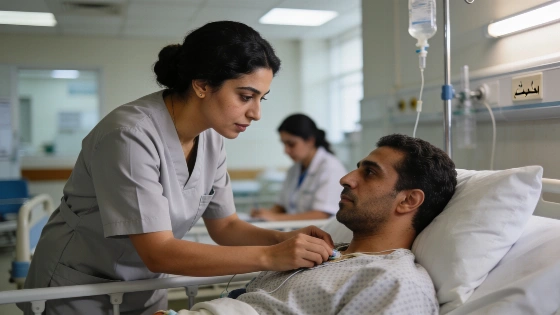
Egypt's GAHAR accredited 945 healthcare facilities across 26 governorates in 2025/26. As the Universal Health Insurance System expands, the focus is shifting to whether training, patient feedback and oversight bring measurable improvements in care.
At a review of GAHAR's annual report, Health Minister Khaled Abdel Ghaffar said the number of accredited facilities was not, by itself, a measure of success. GAHAR accredited 945 healthcare facilities across 26 governorates during the 2025/26 financial year.
Abdel Ghaffar reviewed the report with GAHAR Chairman Ahmed Taha. He said accreditation must lead to improvements patients can feel. The Ministry of Health and Population also reported more than 2,100 regulatory visits as Egypt expands its Universal Health Insurance System (UHIS).
Patient feedback offers one way to check whether standards are making a practical difference. GAHAR collected 168,591 patient-experience questionnaires and 18,615 surveys from healthcare providers. Abdel Ghaffar called on officials to find the reasons for patient dissatisfaction and use the results to improve services.
During the year, the authority carried out around 600 assessment visits and delivered 798 technical support and preparation programmes to 18,016 trainees. Its training centre has trained around 34,000 healthcare professionals with help from 12 universities. Abdel Ghaffar directed GAHAR to extend its programmes to newly appointed doctors and nursing staff. At a separate meeting with the National Academy for Training, Taha said staff development should teach people to interpret and apply standards in practice, not just memorise requirements.
The scale is substantial, but the harder test is whether survey findings lead to changes in care and whether facilities can keep those changes going after assessment.
GAHAR registered 33,233 healthcare professionals and reviewed designs for 26 government healthcare projects during the year. That brought the cumulative number of projects assessed for safe design to 590. The International Society for Quality in Health Care renewed GAHAR's institutional accreditation for four years.
The ministry said GAHAR's 2026 standards for specialised medical centres, private clinics and community pharmacies received international accreditation with an assessment score of 99.6%. The standards cover artificial intelligence, telemedicine, clinical governance, medical tourism, sustainability and green healthcare facilities. They also update requirements for patient safety, surgery, anaesthesia, medication and infection control.
Egypt is also pursuing climate-resilient infrastructure projects, as described in this earlier financing report. GAHAR's accreditation effort, by contrast, depends on how facilities and staff deliver care.
The insurance expansion gives the accreditation drive a wider public-service role. Egypt's Universal Health Insurance Law No. 2 of 2018 established the system and assigned financing, service delivery and accreditation to different public bodies. The state pays contributions for people who cannot afford them. The first rollout phase covered Port Said, Ismailia, Luxor, South Sinai, Suez and Aswan.
Government figures reported in April 2026 showed that more than six million people had registered, while 328 medical facilities had delivered over 105 million services. By October, around 167,000 South Sinai residents were covered, equal to 92.4% of the governorate's population, up from 92.1% a year earlier. Authorities also carried out about 40 field inspections of providers there and required corrective action where they found shortcomings, Ahram Online reported.
The next expansion phase is planned for Minya, Matrouh, Damietta, Kafr El-Sheikh and North Sinai. More than EGP 115 billion has been allocated, and the phase is projected to cover a population of over 12 million. Alexandria was being considered separately at the time of the report. These plans put pressure on quality checks and provider readiness, which will affect the cost and reliability of the larger insurance network.
Egypt is also presenting healthcare delivery and system-building as part of its work with African partners. The Egyptian Healthcare Authority has discussed discounted treatment for African patients, workforce training and sharing experience from universal insurance. In May 2025, it said its facilities had received more than 24,000 patients from 97 countries through its We Care for You in Egypt programme, according to Ahram Online.
Egypt's figures cannot be used as a Maghreb benchmark without comparable data. Morocco's MAP, Algeria's APS and Tunisia's TAP provide national reporting contexts, while UNECA is a continental reference point for economic and development analysis. The figures here describe Egypt's programme, not equivalent accreditation or insurance outcomes in those countries.
Separately, Abdel Ghaffar chaired the seventh meeting of the Medical Professions Risk Compensation Fund board. Members reviewed compensation for deaths and total or partial disability linked to healthcare work, the fund's financial position and investment plans. They also discussed moving its headquarters to the Labour Ministry in December and proposed cooperation with the Ministry of Health and Population, the Egyptian Health Council and the Supreme Council of University Hospitals.
Abdel Ghaffar said the fund should prioritise direct benefits for healthcare workers and help reduce occupational risks. The ministry did not disclose the fund's total revenues or balances, or the value of compensation paid through the end of August.