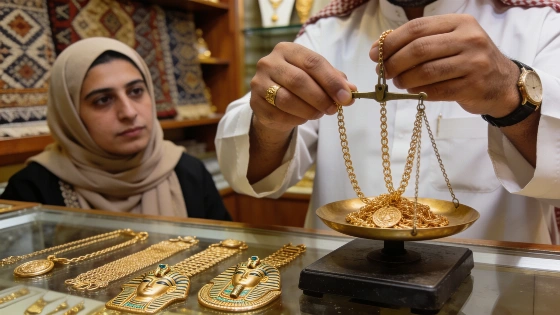
Egyptian gold prices climbed 5.8% last week, reaching an 11-week high as global gold rallied and the Egyptian pound weakened against the US dollar. The move reflects both international market dynamics and shifting local demand.
Gold prices in Egypt rose sharply for a third consecutive week, as global market gains coincided with renewed pressure on the Egyptian pound. Information from Gold Bullion’s technical analysis, 21-karat gold increased by 5.8% last week, from EGP 6,250 per gram at the start of trading to EGP 6,630 by the week’s end. That was a weekly gain of EGP 380, putting 21-karat gold at its highest level in 11 weeks.
The rally pushed gold through several basic resistance levels, including EGP 6,300 and the psychological threshold of EGP 6,500, before it closed above EGP 6,600 per gram. A 1.3% rise in the US dollar exchange rate against the Egyptian pound added to the upward momentum, equivalent to an increase of 65 piastres over the week. Local bullion prices reflect more than the international gold price alone: dealers may also factor in exchange-rate expectations and shifts in local supply and demand, affecting the premium or discount against an implied fair value.
Local Market Dynamics and Consumer Response
Despite the price surge, Gold Bullion noted that gold in Egypt traded at a discount to its fair value for much of the week. It attributed this to relatively subdued domestic demand and increased resale activity, as consumers sought to benefit from higher prices by selling part of their holdings. The resulting increase in supply helped moderate the local premium even as international prices climbed.
The Central Bank of Egypt kept its overnight deposit rate at 19% and its overnight lending rate at 20% at its 9 July 2026 decision. With urban inflation at 14.9% in July, the deposit rate stood above the headline inflation rate at the time. That rate differential can make pound-denominated deposits more attractive than bullion for some savers, while gold may still appeal as a hedge against currency and inflation risks. Urban inflation had risen from 14.3% in June, adding pressure to household purchasing power.
Later data showed annual urban inflation easing to 13.9% in September from 14.5% in August, while monthly inflation rose to 1.3% from 0.1%. Food prices were a basic contributor: annual food inflation rose to 7.2% from 6.3%, while non-food inflation fell to 18% from 19.5%. The Central Bank of Egypt also kept its basic rate unchanged for a fifth consecutive meeting in September, leaving the overnight deposit rate at 19% amid inflation concerns and uncertainty over geopolitical tensions and their effects on energy markets.
International Gold Rally and Outlook
Globally, gold prices advanced 5.2% over the week, with the price per ounce rising from $4,372 to $4,602 and reaching a weekly high of $4,632, its highest level since May. The metal broke out of its previous $4,300 to $4,400 trading range, moving above $4,500 and $4,600, levels analysts see as reinforcing the broader uptrend. International market coverage reported that gold rose 13% in August to about $4,563 per ounce, its third-strongest monthly return in a quarter century and an impressive external driver for bullion prices in Egypt.
Market participants are watching the US Federal Reserve’s policy decisions, with expectations indicating a 65% probability that rates will remain unchanged at the September meeting. Gold Bullion said Egypt’s local market will need to sustain prices above EGP 6,600 per gram to maintain momentum. Further gains will depend on continued international price strength and resilient domestic demand.
Egypt’s foreign-exchange indicators offer context for the currency backdrop. Net international reserves rose from $56.294 billion at the end of July to $57.215 billion at the end of August, while the reported month-end USD/EGP rate moved from 51.0934 to 50.8678. These figures show that the pound’s movement and gold-market pricing pressures do not reflect a single, uninterrupted direction in the official exchange rate. Domestic bullion prices can also reflect global gold movements and local market conditions, including dealers’ exchange-rate assumptions.
A sustained close above $4,600 per ounce would further strengthen the outlook for gold. US interest-rate expectations, shaped in part by movements in the dollar and bond yields, will remain critical, alongside the Egyptian pound and the balance between local buying and resale supply.