
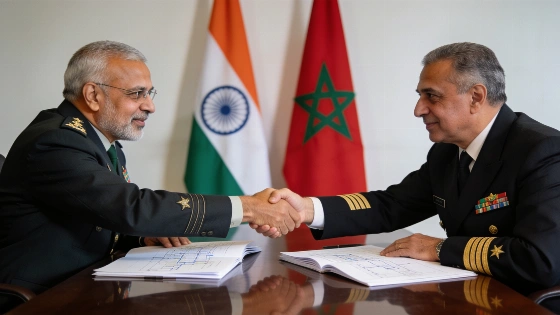
India and Morocco have advanced their defence partnership by launching their Joint Defence Committee in New Delhi, setting the stage for joint projects, technology sharing, and deeper military-industrial ties ahead of the 70th anniversary of diplomatic relations.
India and Morocco have crossed a diplomatic threshold: after years of cautious engagement, the two governments are now openly pursuing joint defence projects, technology transfer, and military-industrial cooperation. The trigger was the inaugural Joint Defence Committee (JDC) meeting in New Delhi, where both sides agreed to move beyond dialogue and into concrete collaboration.
This is not a symbolic gesture. The JDC, co-chaired by Amitabh Prasad from India's Ministry of Defence and Brigadier General Abdellah Athmani of the Moroccan Royal Armed Forces, marks the first tangible outcome of the Memorandum of Understanding signed during Raksha Mantri Rajnath Singh's visit to Morocco in September 2025. That MoU was designed to institutionalise regular defence dialogue, but the New Delhi meeting has now set a new bar: both countries are actively planning joint ventures, co-production, and technology sharing in the defence sector.
From ceremonial visits to operational planning
The Moroccan delegation's four-day visit was more than a diplomatic courtesy. Brigadier General Athmani began by paying respects at the National War Memorial, but the real work took place behind closed doors at DPSU Bhawan, where Moroccan officials scrutinised India's defence manufacturing capabilities. Scheduled tours of the Army Hospital (Research & Referral) further signalled Morocco's interest in India's military medical expertise-a sector often overlooked in bilateral defence talks.
India's team was not limited to the Ministry of Defence. Representatives from the Army, Navy, Air Force, Integrated Defence Staff, Defence Production, Armed Forces Medical Services, DRDO, and the Ministry of External Affairs all took part, underscoring the seriousness of the engagement. The agenda was broad: training, peacekeeping, joint exercises, medical cooperation, cyber defence, and, crucially, defence industry partnerships.
Concrete steps and regional context
What sets this meeting apart is the explicit agreement to explore co-production, joint ventures, and maintenance support. This is a clear pivot from the usual diplomatic choreography to hands-on, operational planning. Both sides are now expected to identify specific projects and timelines, with the 70th anniversary of diplomatic relations in 2027 serving as a natural milestone for early results.
The timing is not accidental. As regional security dynamics shift and external actors deepen their involvement in North Africa, Morocco is seeking to diversify its defence partnerships beyond traditional European suppliers. India's willingness to open its defence sector to joint ventures with Morocco signals a calculated move to expand its own strategic footprint in the Maghreb. This approach echoes the pragmatic risk-taking seen in other recent cross-regional partnerships, such as the reported earlier US business push into Libya despite official warnings.
For Morocco, the benefits are immediate: access to Indian defence technology, training, and medical expertise, plus the prospect of building a more autonomous military-industrial base. For India, the partnership offers a foothold in a region where defence ties have traditionally been dominated by France and the US, and a chance to showcase its manufacturing capabilities to new markets.
What emerges from this summit is not just another round of diplomatic statements, but a deliberate shift toward operational defence cooperation. If both sides deliver on their promises, the India-Morocco partnership could become a model for how emerging powers bypass traditional gatekeepers and build new security architectures in North Africa. The real test will be whether these plans survive the inertia of bureaucracy and the realities of procurement cycles. For now, the intent is unmistakable: both governments are betting that joint action, not just talk, will define the next phase of their relationship.