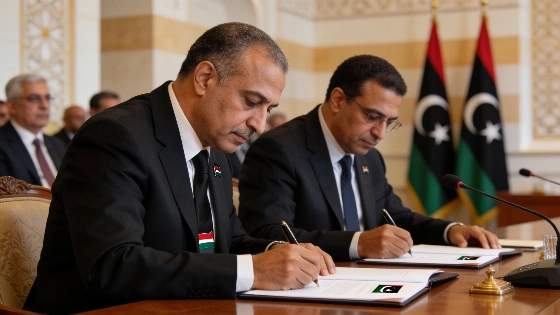
Libya's rival political and security factions have signed a UN-brokered agreement to resolve the election deadlock, but the next two months will reveal whether US and international backing translates into real leverage or remains empty rhetoric.
Libya's fragile political roadmap is now on a collision course with two hard deadlines. The UN-facilitated 4+4 agreement, signed on August 30 by representatives of the country's rival blocs, promises a path out of years of electoral paralysis. But unless Libya's House of Representatives (HOR) and High State Council (HSC) endorse the deal by the end of September, and unless the UN Security Council renews and strengthens the UN Support Mission in Libya (UNSMIL) mandate by October 31, the entire process risks collapse.
Washington and its European partners have been quick to issue statements of support. US Senior Advisor Massad Boulos and other officials welcomed the agreement, insisting that American diplomacy is "fully complementary to UNSMIL's roadmap." Yet, the real test is whether the United States will convert diplomatic language into concrete action as the deadlines approach.
What the 4+4 Agreement Actually Changes
The 4+4 agreement is the product of months of negotiation, bringing together two representatives each from the Government of National Unity (GNU), Khalifa Haftar's General Command, the HOR, and the HSC. Talks began in Rome in April and concluded in Tripoli after seven rounds. The deal addresses two core obstacles: reconstituting the board of the High National Elections Commission (HNEC) and resolving disputes over the legal and constitutional framework for elections. It amends Libya's existing electoral laws, allowing military personnel to run for president and permitting dual nationals to stand, provided they renounce other citizenships before taking office. The agreement also separates presidential and parliamentary results and removes the runoff requirement if a candidate secures over 50 percent of the vote. Crucially, it commits all parties to holding elections within twenty-four months under a unified executive authority-though it offers no mechanism for forming that authority.
But the agreement's fate is far from secure. The HOR and HSC have until the end of September to endorse it. If they stall or refuse, the fallback is to seek broader national and international backing, potentially escalating the issue to the UN Security Council just as UNSMIL's mandate comes up for renewal.
Political Maneuvering and Risks of Sabotage
Initial reactions from Libya's power centers reveal deep skepticism. Prime Minister Abdulhamid Dbeibah and Khalifa Haftar both publicly welcomed the agreement, but HOR Speaker Aguila Saleh conditioned his support on its alignment with Libya's existing legal framework. HSC President Mohammed Takala refused to attend the signing, and the HSC later warned against "the imposition of arrangements from outside Libya's institutional framework." Meanwhile, Presidential Council President Mohammed Menfi issued a decree naming a rival HNEC board on the very day of the signing, underscoring the persistent institutional fragmentation.
Neither the HOR nor the HSC needs to formally reject the agreement to derail it. They can simply avoid convening, fail to reach quorum, or demand further revisions-tactics that have repeatedly stalled previous deals, including the 2015 Libyan Political Agreement. As seen in other regional negotiations, such as the reported earlier between Algeria and Niger, procedural delays and institutional rivalries can be just as decisive as outright opposition.
What Washington and Its Partners Can Actually Do
For the United States, the next two months are a credibility test. Three concrete steps could shift the balance: First, Washington should use the upcoming UN General Assembly to secure a joint statement from key international partners-Turkey, Egypt, Qatar, Saudi Arabia, the United Arab Emirates, France, Germany, Italy, and the United Kingdom-explicitly endorsing the 4+4 agreement and pledging support for its implementation. Second, the US mission in New York must push for a Security Council mandate that not only renews UNSMIL but also explicitly backs the agreement and requires regular reporting on progress. Last, the US Treasury and State Department should prepare targeted sanctions packages against individuals or factions that obstruct or delay the process, drawing on precedents from 2016 when both the US and EU sanctioned Libyan spoilers.
Without these moves, the risk is clear: Libya's rival institutions could exploit procedural ambiguities to stall or sabotage the process, while the UN mission is left with a weak mandate and little leverage. The 4+4 agreement is not a guarantee of elections, nor does it erase doubts about Washington's bilateral diplomacy, which has sometimes appeared to undercut the UN process by engaging directly with rival power centers. But it does create a narrow window for alignment-if the US and its partners are willing to act decisively.
As the deadlines approach, the gap between rhetoric and reality will become impossible to ignore. If Washington limits itself to statements of support while Libya's institutions revert to familiar delaying tactics, the opportunity for a unified electoral process will evaporate. The coming weeks will reveal whether US policy is prepared to back words with action-or whether Libya's political future will once again be sacrificed to inertia and institutional self-preservation.