
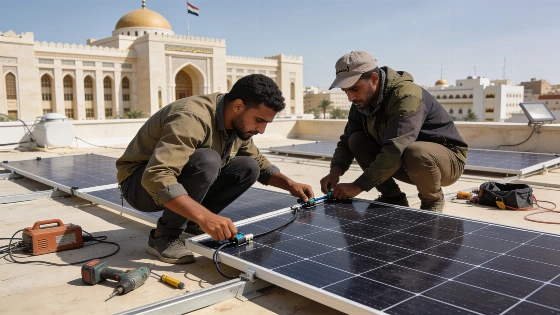
Facing a summer of crippling blackouts and public unrest, Libya's Minister of Labour and Rehabilitation has mandated solar panel installations at ministry buildings, testing whether government energy directives can outpace the country's chronic grid failures.
Heart surgeries for children cancelled, state buildings barricaded, and angry crowds blocking roads-Libya's electricity crisis this summer was not just an inconvenience, but a direct threat to public order and essential services. The government's inability to keep the lights on nearly toppled Prime Minister Abdel Hamid Aldabaiba, as power cuts spiraled into violent demonstrations and institutional paralysis.
Now, in a move that signals both desperation and a bid for credibility, Minister of Labour and Rehabilitation Ali Al-Abed Al-Reda has instructed his ministry's Project Management Team to install solar panel systems across ministry buildings. The order, delivered at the Fourth Meeting of Department and Office Directors in Tripoli, is pitched as a first step toward energy efficiency and consumption rationalization-but it is also a test of whether government mandates can translate into real-world action.
Solar Mandate: Policy or Performance?
This is not the first time Libya's Tripoli-based authorities have tried to force a renewable energy pivot. Directive No. 219765, issued in August 2025 by the General Electricity Company of Libya (GECOL), required all government buildings to adopt solar systems. Yet, months later, implementation remains patchy at best, with most ministries still tethered to an unreliable grid. The Labour Ministry's new push is the first concrete sign that at least one department is willing to move beyond paperwork.
The urgency is clear. Power failures have already forced Tripoli University Hospital to halt critical operations, including joint procedures with visiting US specialists. The wider economic and social fallout has been severe, as documented in reported earlier by Maghreb Insider, with GECOL fielding nearly 10,000 outage complaints in a single day. The government's credibility is now directly tied to its ability to deliver basic services-and to show that its own ministries are not exempt from the rules it sets.
Inside the Ministry: Digital Upgrades and Workforce Training
The solar initiative is only one part of a broader internal overhaul. The same meeting reviewed the status of the ministry's digital transformation plan, including the rollout of a comprehensive platform and associated applications. Directors discussed the readiness to launch the solar project's first phase at the Tripoli headquarters, as well as strategies to upgrade digital infrastructure across departments to improve operational efficiency and service delivery.
Vocational training and rehabilitation programs are also on the agenda, with proposals to reactivate training centres through cross-sector partnerships. Meanwhile, preparations are underway for a new labour inspection campaign, following the approval of a training plan to boost inspection team readiness. The ministry claims it is investing in professional development for staff, particularly in administration and English language skills, to strengthen institutional performance.
But the real test is not in the number of meetings or the volume of plans. Libya's ministries have a long history of ambitious directives that stall at the implementation stage. The Labour Ministry's solar order will be watched closely-not just as a technical upgrade, but as a litmus test for whether the government can break the cycle of inertia that has left the country in the dark. If the panels go up and the lights stay on, it will mark a rare instance of policy translating into tangible results. If not, the gap between official rhetoric and lived reality will only widen, further eroding public trust in Libya's governing institutions.