The death of Cheikh Mohamed El-Hassan Ould Ahmedou El-Khadim marks the end of an era for Mauritania's traditional Islamic education, as the architect of Mahadra Taysir leaves behind a legacy spanning over a hundred scholarly works and generations of students.
With the passing of Cheikh Mohamed El-Hassan Ould Ahmedou El-Khadim, Mauritania's Mahadra system has lost one of its last living pillars-a scholar whose influence radiated far beyond the remote village of Taysir, shaping Islamic education across West Africa and the wider Muslim world.
His death, announced after a lifetime spent teaching, writing, and mentoring, is not just a personal loss for his family and disciples. It signals a turning point for the country's centuries-old tradition of knowledge transmission, which now faces the challenge of continuity in a rapidly changing educational landscape.
Mahadra Taysir: From Desert Outpost to Regional Beacon
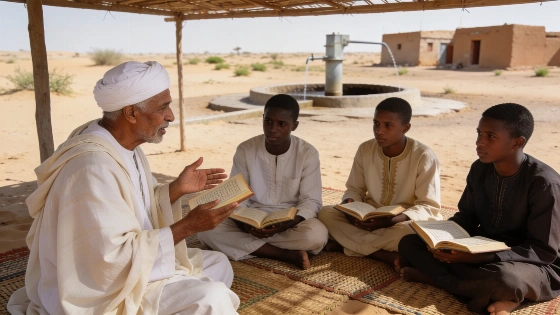
What began as a modest gathering around a hand-dug well in Nkeykim, north of Tiguind, evolved under Cheikh Mohamed El-Hassan's leadership into Mahadra Taysir-a village and institution inseparable from his name. By 1974, the settlement had become a magnet for students from across Mauritania, West Africa, the Maghreb, and even Asia, all seeking the rigorous, text-based instruction that defined the Chinguetti tradition.
Unlike modern universities, Mahadra Taysir thrived on oral transmission, memorization, and daily engagement with foundational texts. Its alumni now serve as imams, judges, and educators across continents, a testament to the reach of the cheikh's teaching model. The Mahadra's survival, however, is increasingly tested by the pressures of modernization and the lure of formal academic credentials-a dilemma echoed in other regional education debates, as reported earlier in Algeria's own struggles with educational reform.
Scholarship Rooted in Tradition, Shaped by Need
Cheikh Mohamed El-Hassan's intellectual output was staggering: more than a hundred works spanning jurisprudence, hadith, Sira, Arabic grammar, and educational ethics. Titles such as "Maram al-Mujtadi min Sharh Kaffaf al-Mubtadi" and "Dalil al-Nasik li-ma yakhfi min al-Manasik" became essential reading for Mahadra students, while his commentaries on "Mutahhara al-Qulub" and "Bughyat al-Abrar" bridged classical texts with contemporary needs.
His approach was never academic for its own sake. Each book, poem, or treatise was crafted to address the concrete questions facing his students-whether clarifying the rules of mosque etiquette, the conduct of the sick, or the intricacies of Quranic recitation. The Mahadra's daily teaching circle and the cheikh's written legacy were two sides of the same coin, reinforcing a living tradition rather than preserving it in amber.
Born in 1938 in Trarza, into a family steeped in scholarship and piety, Mohamed El-Hassan's earliest lessons came from his grandmother, Fatima bint Mohamed El-Tahji, and his father. He absorbed the full spectrum of Islamic sciences, from Quranic memorization to the study of Ibn Achir and El jaroumiya, before earning certification from the renowned Mohamed Salim Ould El-Mokhtar Ould Elouma. Even as a student, he began teaching-an early sign of the seamless blend between learning and instruction that would define his career.
Legacy, Loss, and the Question of Continuity
The cheikh's death has prompted an outpouring of condolences from his family, students, and admirers. In a statement, his relatives emphasized his wish for restraint: condolences should be offered only by phone, with no travel or gatherings, in line with his prior instructions. This insistence on simplicity and focus mirrors the ethos of his life's work-eschewing spectacle in favor of substance.
For Mauritania, the loss is acute. The Mahadra system, already under strain, now faces the daunting task of sustaining its intellectual rigor and social relevance without one of its most effective stewards. The vacuum left by Cheikh Mohamed El-Hassan is not easily filled; his unique combination of erudition, pedagogical innovation, and community leadership set a standard few can match.
As the region grapples with the future of Islamic education, the lesson from Taysir is clear: the survival of tradition depends not on nostalgia, but on the ability to adapt without surrendering core values. Cheikh Mohamed El-Hassan Ould Ahmedou El-Khadim's legacy is not merely a collection of books or a list of disciples-it is a living challenge to the next generation to build, teach, and write with the same clarity of purpose. Anything less would betray the very tradition he spent a lifetime defending.