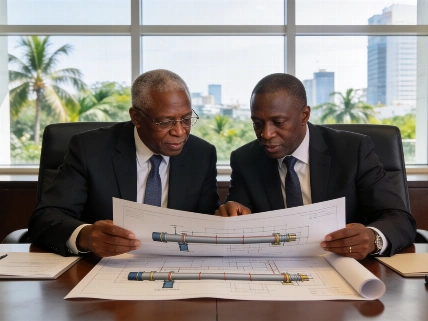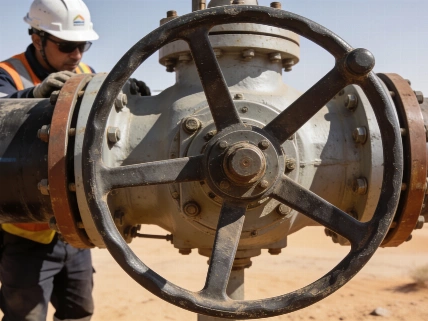

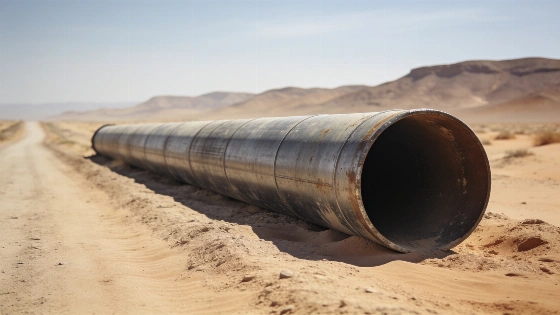
OPEC Secretary General Haitham Al-Ghais has backed the proposed pipeline from Nigerian gas fields through Niger to Algeria, with a possible link to Europe. Niger expects route surveys to begin in early October 2026, but the project still has no full delivery timetable.
At talks in Niamey on 22 September 2026, Algeria and Niger agreed to speed up preparatory work on the Nigerien section. OPEC Secretary General Haitham Al-Ghais has also endorsed the Trans-Saharan Gas Pipeline (TSGP), calling it an "excellent project." The pipeline is still in development, not an operating export route. On Niger's section, practical fieldwork is now planned.
Speaking to Algerian television channel Ennahar, Al-Ghais said the project could strengthen energy security and create economic opportunities in Nigeria, Niger and Algeria. The proposal would connect Nigeria, a major gas producer, to Algeria and could link to existing pipelines that carry gas to Europe. Its regional-integration case fits the wider cross-border infrastructure agenda discussed by the African Union and the UN Economic Commission for Africa. That context is not proof of project financing or approval.
Recent regional reporting puts the proposed route at about 4,128 kilometres, from Warri in Nigeria to Hassi R'Mel in Algeria. Roughly 841 kilometres would cross Niger, according to Afrik.com. Some recent estimates put planned capacity at around 30 billion cubic metres of gas a year. That is a design estimate, not current throughput.
Algeria and Niger also agreed to move ahead with topographic surveys, geotechnical studies and an environmental impact assessment for the Nigerien section. Niger says topographic surveys are expected to start in early October, as reported by Maghreb Emergent. No official date has been set for construction on Niger's section. Survey work comes first.
Regional coverage says Algeria launched construction on its own section in June 2026. That points to movement beyond political support, but it does not mean work has begun along the full route. Niger's preparatory studies are still pending, and the status and timetable for Nigeria's section remain separate questions. Algeria's state news agency, APS, is one official channel for tracking Algerian announcements. Updates cited here do not set out a complete construction schedule or financing plan.
The Nigerien Ministry of Petroleum has called the pipeline strategically important to Algeria, Niger and Nigeria. According to Afrik.com, the ministry described it as a possible tool for African energy integration and regional socioeconomic development. Those aims fit the African Union and UNECA's wider focus on regional connections. Governments and project partners still need to settle the practical demands of a large cross-border project.
Al-Ghais said construction could create jobs for young people and spur economic activity in communities along the route. He also described Algeria's work to advance the project as part of a wider push for regional and continental integration. These benefits are prospective. They depend on construction and operation, gas supply arrangements, and commercial access to export markets.
For Nigeria, the route could offer another way to earn revenue from its gas resources. Niger and Algeria could see economic activity along the cross-border corridor. The project's estimated scale and capacity give it strategic weight, but detailed engineering, environmental review, security planning and financing are still needed before projected gains can be delivered. Gains remain uncertain.
A separate regional assessment looks at Morocco's potential role in European clean-technology supply chains. The gas proposal has a different focus: a route across Nigeria, Niger and Algeria. The broader question is whether regional infrastructure plans can become working links to external markets.
Al-Ghais's endorsement gives the project a prominent public backer, but it does not guarantee delivery. The next measurable milestone is the start and completion of Niger's planned surveys. After that, project partners still need decisions on engineering, financing and construction schedules. Until the pipeline is built and operating, its expected contribution to energy security and job creation remains a projection, not an outcome.