
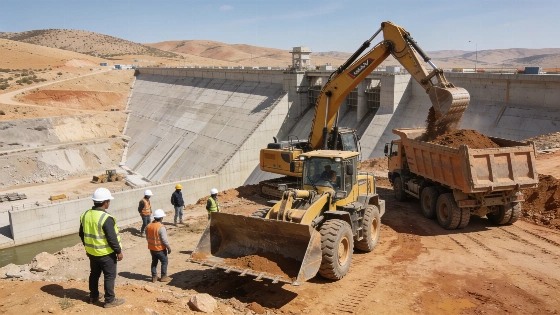
The Opec Fund for International Development has approved $645 million for infrastructure and economic reform, with Morocco and Oman together receiving $200 million. Morocco will use its $150 million share to build a major dam aimed at improving water security.
Morocco will receive $150 million from the Opec Fund for International Development to build a new dam, the largest single allocation in the Fund's latest $645 million financing round. The project is intended to improve water security and help the country cope with climate-related challenges. This funding is part of a broader package for infrastructure and economic reform in more than a dozen countries, according to the Maghreb Arab Press (MAP) and Morocco's Ministry of Equipment and Water.
The Opec Fund, created by the Organization of the Petroleum Exporting Countries (Opec) in 1976, is providing $200 million in total to Morocco and Oman. Oman will receive up to $40 million for the Plaza District in Yiti Sustainable City, a mixed-use development that aims for net-zero emissions by 2040. The rest of the funding is distributed among other countries, but Morocco's dam project is notable for its size and its role in tackling the country's ongoing water shortages, an issue regularly cited by the United Nations Economic Commission for Africa (UNECA).
Focus on water and climate adaptation
The new dam in Morocco is designed to reduce flood risks and support agriculture, directly addressing the country's exposure to drought and unpredictable rainfall. The Opec Fund's president, Abdulhamid Alkhalifa, said these investments are meant to support reliable water and energy, resilient infrastructure, and access to finance-key elements of sustainable development. Morocco's Ministry of Equipment and Water describes such projects as essential for protecting rural communities and food security in areas hit hardest by climate shifts.
Oman's Yiti Sustainable City project is intended as a model for urban sustainability in the Gulf. The Plaza District is planned as a central area for business and community life, in line with Oman Vision 2040 and overseen by the Ministry of Housing and Urban Planning. Both projects fit the Opec Fund's goal of helping partner countries address immediate needs while building long-term resilience, as noted in recent statements from the Arab Maghreb Union and regional development agencies.
Regional and institutional context
The Opec Fund's latest approvals also include projects in Argentina, Belize, Cambodia, El Salvador, Sierra Leone, Tajikistan, Sri Lanka, Zambia, Armenia, Azerbaijan, Kazakhstan, and Paraguay. Since 1976, the Fund has committed over $32 billion to development projects in more than 125 countries, mainly outside Opec. This latest round highlights the Fund's ongoing focus on infrastructure and climate adaptation in North Africa and beyond.
In July, Fitch Ratings reported that the Opec Fund's non-performing loan ratio fell to 0.7 percent in 2025, citing growth in its loan book and no recent write-offs. Fitch described the Fund's liquidity and asset quality as "excellent," with "strong" access to capital markets. This financial position supports the Fund's ability to back large infrastructure and reform projects, a point also mentioned by Tunis Afrique Presse (TAP) in its regional analysis.
Morocco's emphasis on major infrastructure and social investment is longstanding. As reported earlier, political groups in the country have recently announced multi-billion dollar plans for social and economic change, highlighting the importance of development finance in Morocco's national agenda. More information on Morocco's infrastructure plans is available from the official portal of the Ministry of Equipment and Water.
The Opec Fund's latest round of funding reflects a focus on the region's most urgent infrastructure and climate issues. By investing in water security and sustainable urban development, Morocco and Oman aim to reduce future risks and attract further international investment. These projects show that targeted development finance remains central to building resilience and economic opportunity in North Africa and the Gulf.