
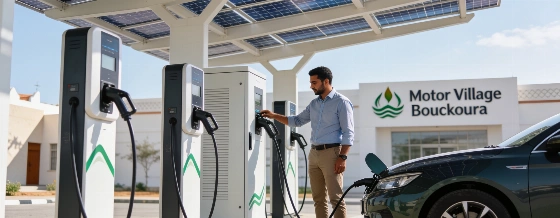
Stellantis Morocco has launched a fully off-grid, solar-powered EV charging station at its Motor Village Bouskoura site, testing how clean mobility infrastructure can be quickly deployed in areas without reliable grid access.
Stellantis Morocco has taken a direct approach to the country's lack of electric vehicle infrastructure by launching a fully autonomous, solar-powered charging station at its Motor Village Bouskoura headquarters. This isn't a grid-connected demo for city showrooms-it's a working test to see if clean mobility can reach Morocco's remote and underserved communities without waiting for public investment. The project is already running and will be evaluated over a year in partnership with Solar Power, a Moroccan renewable energy company, according to LeBrief and the Moroccan Press Agency (MAP).
The station was designed by a Stellantis engineer in Morocco through the group's Star*Up intrapreneurship program. It runs entirely off-grid. A photovoltaic canopy generates electricity whenever there's sunlight, and an integrated battery system-built from repurposed Stellantis micromobility batteries-stores extra energy for use at night or on cloudy days. The setup provides four AC charging points for electric vehicles, plug-in hybrids, and micromobility solutions, with charging up to 19 kW. An intelligent system manages energy flows independently of the national grid. Project data shows the station can charge up to eight plug-in hybrids or three full electric vehicles per day under ideal conditions, which is notable for a standalone installation in the Maghreb.
Testing autonomy in the field
Unlike standard charging stations, this one doesn't need a grid connection or government approval. Its plug-and-play design means it can be quickly set up in sun-rich regions, at logistics hubs, hotels, or rural communities. The pilot, developed with Solar Power, will run for a year to collect real-world performance data and customer feedback. Solar Power CEO Imad El Idrissi has said the pilot is meant to test a "genuinely autonomous, off-grid model" for Morocco's remote and underserved areas, a goal also mentioned by the Ministry of Energy Transition and Sustainable Development.
The station also includes two 230V household outlets for micromobility vehicles like the Fiat TRIS, which can charge from 20 to 80 percent in about four hours. The battery storage, made from reused micromobility batteries, addresses the challenge of charging at night or during cloudy weather-an issue that has slowed solar mobility projects elsewhere in the region. The Tunis Afrique Presse (TAP) agency has reported similar problems in Tunisia's rural electrification efforts, showing the wider relevance of such autonomous solutions.
Strategic implications for Morocco's mobility transition
Morocco's national grid doesn't reach everywhere, and rural electrification is still incomplete. The ability to deploy autonomous charging stations could help close these gaps. Stellantis isn't the only one targeting infrastructure shortfalls: Algeria's telecom regulator recently launched a national tender to extend mobile coverage to 3,000 remote areas, as reported earlier. Both efforts reflect a growing sense that traditional infrastructure rollouts are too slow for isolated communities and new mobility needs. The Moroccan Ministry of Energy Transition sees decentralized energy solutions as increasingly important for meeting climate and electrification targets under the Green Generation 2020-2030 strategy.
Stellantis is using its Star*Up program-meant to turn employee ideas into scalable commercial solutions-to try to move beyond small improvements. If the Bouskoura pilot works, the company will have a model for quickly deploying clean mobility infrastructure across Morocco's sun-rich but underserved regions. The main question is whether this approach can scale beyond a single site and provide reliable, affordable charging where the grid doesn't reach. Regional observers, including the United Nations Economic Commission for Africa (UNECA), have noted that if these pilots succeed, they could serve as templates for wider adoption in North Africa.
Stellantis Morocco's off-grid charging pilot is a rare case of a global carmaker investing directly in practical, inclusive clean mobility. If the company follows through on its plan to expand access in underserved areas, it could set a new standard for innovation in the Maghreb's energy transition-one that other manufacturers and policymakers may have to match.