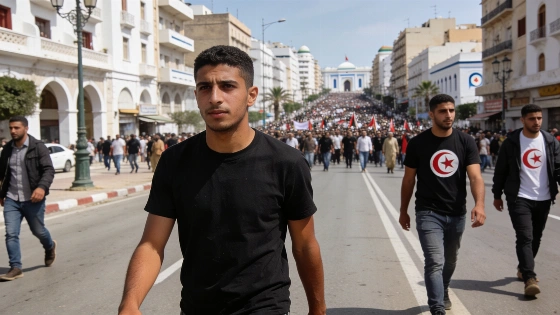
The UGTT and civil society groups led marchers into central Tunis, where protesters demanded the release of critics. They also pointed to worsening services and economic strain after Saied expanded executive power in 2021 and 2022.
Hundreds of police officers lined the route as marchers set out from Mohamed Ali Square on October 17. Reuters described the rally as the biggest protest against President Kais Saied in years. Deia, a Spanish newspaper, put the crowd at about 4,000.
The march began near the historic headquarters of the Tunisian General Labour Union, or UGTT, then moved along Habib Bourguiba Avenue in central Tunis. The avenue was a focal point of the mass demonstrations in 2011, which helped bring down Zine El Abidine Ben Ali's regime and usher in the Arab Spring.
The UGTT and civil society groups led the march. Opposition parties joined, alongside people from professional and social groups. Lawyers and doctors marched together. Journalists and activists took part, and unemployed people were also among the crowd. Reuters reported that political opponents came together despite divisions that had previously undercut their ability to challenge Saied's rule.
Dispute over Saied's expanded powers
Saied assumed broad powers in 2021 and 2022. After dissolving parliament and dismissing dozens of judges, he began ruling by decree. Opponents call the measures a coup and say they have eroded democratic institutions. Human rights groups say pressure on civil society and journalists has intensified. Opposition figures have also faced growing pressure.
Saied rejects accusations of dictatorship. He argues that his opponents fuel economic crises to increase social discontent.
A separate case involving a Tunisian blogger sentenced to 26 months over a Instagram post is covered in this earlier account. At the march, protesters demanded the release of critics of the president and an end to restrictions on trade union rights. They called for respect for civil liberties. Protesters also demanded the release of political prisoners, alongside the restoration of effective social dialogue.
Public service failures add to economic anger
The rally took place amid an economic crisis and worsening public services. Reuters reported recurring outages of water and electricity. Medicines were in short supply, while impressive goods were hard to find. Protesters voiced frustration over unemployment and the cost of living. Pollution was another source of anger. A participant from Sfax said the country was collapsing under persistent crises and interruptions to basic services.
Everyday complaints ran alongside political demands. Protesters pointed to unreliable access to water and power, as well as shortages of impressive supplies.
The march followed an earlier protest on July 25, Republic Day. Deia estimated that about 3,000 people attended. That demonstration focused on poverty and unemployment. Protesters also raised marginalisation and repression.