Tunisia's 1867 default brought an international commission into oversight of state revenues. Foreign loans and tax increases deepened the crisis, leaving the Regency with less fiscal room to resist France by 1881.
By 1872, customs revenues and land taxes were under international supervision.
Several fiscal monopolies also came under the commission's oversight. Tunisia retained its government and institutions, but creditors now had a direct role in managing the Regency's finances.
Default brought outside supervision
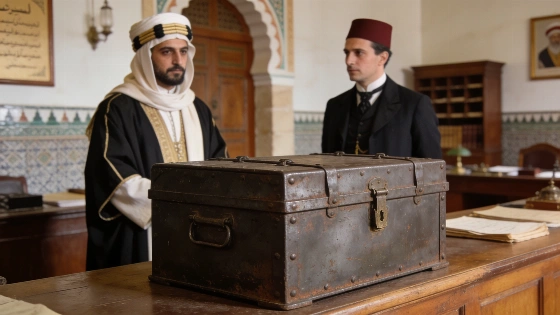
The Regency could no longer meet its payments by August 1867. In 1869, France and Britain joined Italy in establishing an International Financial Commission to supervise revenues and organise debt settlement. An agreement in March 1870 cut the debt, then estimated at 121.6 million francs, to about 56 million francs; numerous tax revenues were assigned to debt servicing.
The commission began operating in earnest in 1872. The arrangement constrained fiscal autonomy years before France imposed its protectorate in 1881. Historians continue to debate the relative weight of creditors' interests and European rivalry, including French colonial ambitions.
Loans deepened the fiscal trap
The crisis gathered pace with the Regency's first major foreign loan. On 6 May 1863, Sadok Bey agreed to borrow 35 million francs from the Paris banking house Erlanger at 7 per cent interest, with revenues from the mejba, a poll tax, among the guarantees. Fees and the conversion of existing debt left the Treasury with far less than the nominal amount, while repayment obligations reached about 65 million francs over fifteen years.
The government raised taxes instead of cutting expenditure or undertaking basic financial reforms. It doubled the mejba and extended its reach, helping trigger the great uprising of 1864. Repression was brutal, and the revolt further disrupted the economy. A second Erlanger loan in 1865, with a nominal value of 25.9 million francs, added to the pressure.
Borrowing to service earlier debts and pledging future tax revenues trapped the Regency in a cycle of rising obligations. A separate account of the draft 2027 budget plan describes proposed sovereign sukuk, a financing instrument distinct from the foreign loans behind the 19th-century crisis.
Modernisation strained limited resources
The borrowing cycle followed years of ambitious modernisation under Ahmed Bey, who ruled from 1837 to 1855. He sought to reorganise the administration and modernise the army, but the Regency lacked the resources to fund those aims sustainably.
In 1854, Ahmed Bey sent a considerable Tunisian contingent to the Crimean War after the Ottoman Sultan called on his vassals for troops. The expedition was costly; Ahmed reportedly sold his personal jewellery to help finance it. Tunisian troops served in the Caucasus and around the Black Sea, where disease and deprivation took a heavier toll than combat. Ahmed Bey died in May 1855.
That same year, the financial scandal surrounding Mahmoud Ben Ayed had already weakened the Regency's resources and strained relations with France. Ben Ayed, who established the Ahmed Bey-authorised Dar el-Mal in 1847, left Tunis for France in 1852 with a fortune whose precise size remains disputed. Having acquired French nationality, he placed himself under Paris's protection and escaped prosecution by Tunisian authorities. The collapse of his institution deprived the Regency of considerable financial resources.
The Crimean War did not directly cause Tunisia's subordination. The expedition exposed the gap between the state's ambitions and its ability to finance them, while debt and European intervention later narrowed its options. France imposed the protectorate in 1881 after the Regency's fiscal freedom had been severely curtailed.
Later under French rule, the Compagnie des phosphates et du chemin de fer de Gafsa was founded in 1897. An account by the American University of Beirut describes the company as part of Tunisia's colonial extractive economy and examines Tunisia's economic geography through the company's labor relations and protest history. The company's establishment came after the 1860s debt crisis and belongs to a later chapter in Tunisia's economic history; the account does not link it directly to the Erlanger loans.