Sara Zaafrani Zenzri praised the Africa-Russia action plan for 2027-2029 and urged practical cooperation, while calling for African-led conflict prevention and stronger capacity in basic development sectors.
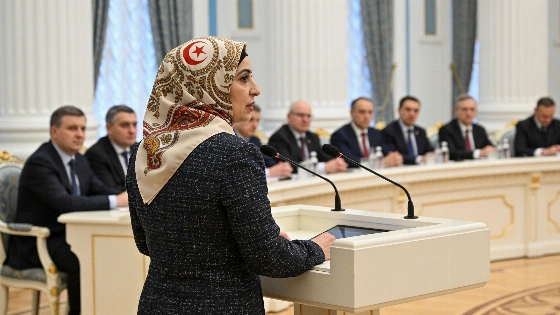
The Africa-Russia partnership action plan for 2027-2029 covers trade and investment, health, energy, technology, education and culture, Tunisian Prime Minister Sara Zaafrani Zenzri said at the summit in Moscow. She said Tunisia was ready to contribute expertise and human resources to help put it into effect.
Zaafrani Zenzri spoke on Thursday, October 29, at the opening of the third Russia-Africa summit at the Kremlin. Russian President Vladimir Putin chaired the meeting. Tunisia's Foreign Minister Mohamed Ali Nafti attended with the accompanying delegation. The two-day summit, held on October 28-29, brought together representatives of almost 50 African countries. The Kremlin said its agenda covered political relations, trade, investment, science and technology, and humanitarian and cultural cooperation.
On the summit's sidelines on October 28, African Union Commission Chairperson Mahmoud Ali Youssouf and Russian Foreign Minister Sergey Lavrov signed the Russia-African Union Commission Action Plan for 2027-2029. The African Union said the structure covers 19 areas, including peace and security, artificial intelligence, digital change, cybersecurity, space technology, energy, transport infrastructure, agriculture, water management, climate adaptation, health, education, trade and investment. The African Union statement describes it as an institutional structure for structured cooperation over the three-year period.
Security and development priorities
Zaafrani Zenzri described an international field shaped by intersecting crises, armed conflicts and economic disruption. She also cited energy shocks, health threats and climate risks, saying their cross-border effects call for broad cooperation.
She said peace and security are prerequisites for development in Africa and urged greater investment in preventive diplomacy. Tunisia supports African Union mechanisms for early warning and mediation, as well as the peaceful settlement of disputes.
She linked tensions to economic and social vulnerability and to marginalization. Strengthening national and regional institutions, she said, could help contain crises before they escalate. She also reaffirmed Tunisia's support for "African solutions to African problems" based on dialogue and respect for sovereignty and territorial integrity.
The African Union's action plan also identifies peace and security as a basic area of cooperation. It includes counterterrorism, efforts against transnational organized crime, exchanges of expertise and institutional capacity-building. The AU linked these priorities to its "Silencing the Guns in Africa by 2030" initiative.
On food security, the prime minister called for investment in agricultural production and food industries. She also urged better water management and technology exchange, along with improvements to storage, processing and distribution systems. She cited climate change and supply-chain disruption among the pressures facing the continent.
Health security was another priority. Zaafrani Zenzri called for stronger prevention and response capacity, regional coordination and cooperation in research and medical training. She cited the Ebola epidemic as a threat to Africa and the wider world, and urged support for surveillance and early-warning systems, as well as greater capacity to produce medicines and vaccines.
Zaafrani Zenzri called for joint investment in energy infrastructure and better access to financing and technology. The aim, she said, should be reliable and affordable energy alongside a fair transition that reflects African countries' development priorities. On climate change, she urged financing for adaptation and access to technology and knowledge.
Zaafrani Zenzri also pointed to young people as a force for change, calling for quality education, vocational training and access to employment. She said educational reform should keep pace with technological change.
Ties with Moscow and multilateral reform
At the start of her address, Zaafrani Zenzri conveyed greetings from President Kais Saied and thanked Vladimir Putin for hosting the summit. She recalled that diplomatic relations between Tunisia and the Soviet Union were established on July 11, 1956, a few months after Tunisian independence. She said Soviet support contributed to development and scientific projects, including training Tunisian engineering experts and cooperation in health.
She said Tunisia wanted to develop relations with Russia on the basis of mutual interest and respect. The prime minister also called for reform of the United Nations system, saying its current structure was struggling to respond effectively to international crises.
She cited the UN's failure to stop what she described as historical injustice and genocide against the Palestinian people, as well as settlement and starvation policies. She argued that peace depends on justice and adherence to the UN Charter, and called for fairer representation of Africa and developing countries in a reformed international order.
Zaafrani Zenzri praised the 2027-2029 action plan's goals and said Tunisia would mobilize its expertise and human resources to support its implementation. She urged both sides to turn agreements into concrete results. The summit's planned outcomes included a final declaration, a Russia-Africa Partnership Forum action plan for 2027-2029 and a separate declaration on civilian applications of artificial intelligence, as set out in the Kremlin's summit brief.